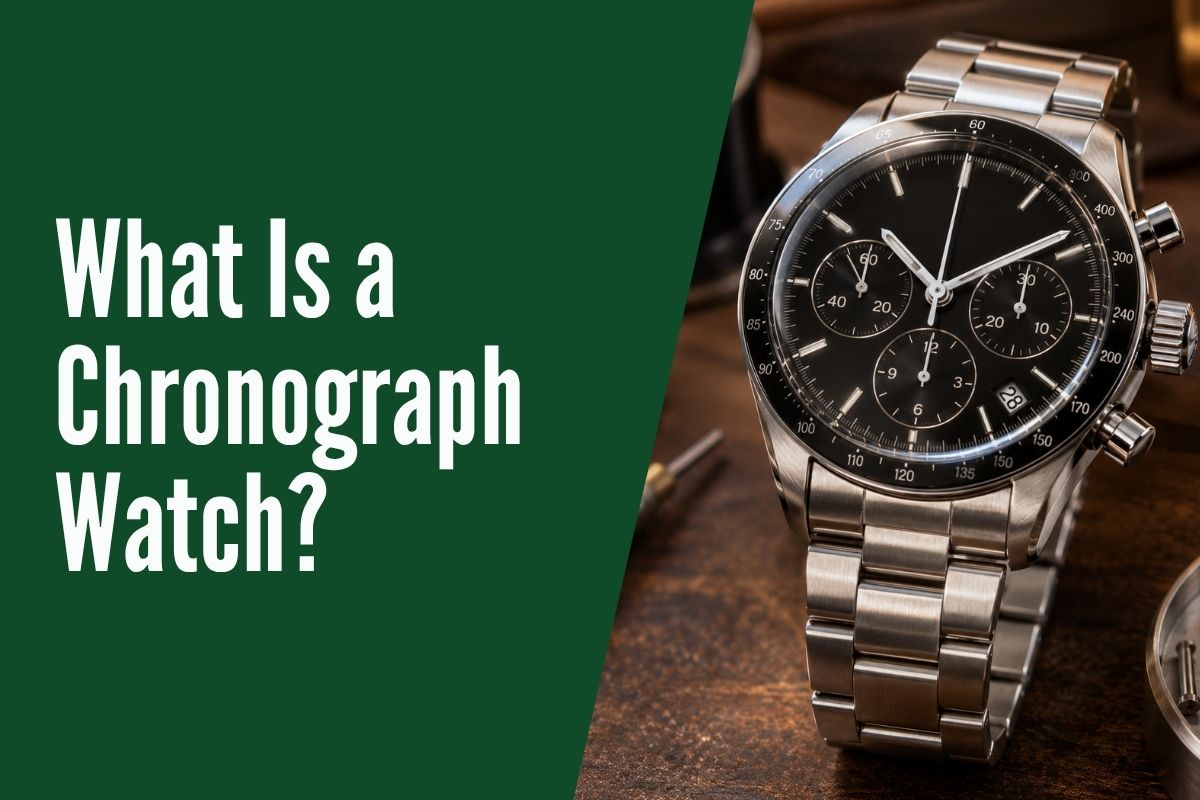
Why do some watches have three smaller dials and two extra buttons? You have probably noticed them on luxury models such as the Rolex Daytona or Omega Speedmaster. They are characteristic features of a chronograph, a watch that also works as a stopwatch.
Although chronographs have been around for generations, their functions still puzzle many first-time buyers. And with so many different designs available, it is not always easy to tell what each feature does.
If you are considering buying one, there are a few things worth knowing before you make your choice.
What Makes a Watch a Chronograph?
A chronograph watch is a timepiece with a built-in stopwatch function that measures elapsed time while continuing to display the current time. You can use it to time activities such as running, cooking, or racing without affecting the regular watch hands.
Most chronographs have one or two buttons, known as pushers, beside the crown. These control the stopwatch, allowing you to start, stop, and reset the timing function independently.
The main difference between a regular watch and a chronograph is:
- Regular watch: Displays the current time.
- Chronograph watch: Displays the current time and measures how long an activity takes.
You might recognise chronographs by their smaller dials, called subdials or registers. However, multiple subdials alone do not make a watch a chronograph.
Their arrangement varies depending on the brand and movement, or calibre. Some models measure seconds and minutes, while others also record elapsed hours.
How Does a Chronograph Watch Work?
A chronograph uses a separate timing mechanism within the watch movement, allowing you to measure elapsed time without interrupting the regular clock. On most models, you operate the stopwatch using two pushers positioned beside the crown.
Here is how the main components work:
- Crown: Used to set the time and, depending on the movement, wind the watch or adjust the date.
- Start/stop pusher: Usually located at 2 o'clock, this button starts the chronograph when pressed once and stops it when pressed again.
- Reset pusher: Typically found at 4 o'clock, it returns the stopwatch hands to zero after timing has stopped.
- Central chronograph seconds hand: The long hand measures elapsed seconds when you activate the stopwatch.
- Subdials or registers: Smaller displays that record elapsed minutes and sometimes hours. One may also show the regular running seconds.
One detail often confuses new owners. On many chronographs, the large central seconds hand remains stationary until you start the stopwatch. The watch itself is still running, with the regular seconds often displayed on a smaller subdial.
Once activated, the chronograph seconds hand begins moving, while the relevant counters record longer intervals. You can then stop the measurement, read the elapsed time, and reset the display.
These controls describe a conventional chronograph. Models with specialised functions, such as flyback or split-seconds timing, operate differently. Always consult the instructions for your watch's specific calibre.
What Are the Small Dials on a Chronograph Watch For?
The small dials on a chronograph have different jobs. Some keep track of elapsed time when you use the stopwatch, while others continue running as part of the watch's normal timekeeping. These displays are called subdials or registers, with those adding up elapsed time also known as totalisers.
Most chronographs include some combination of the following:
- Running seconds: Shows the current seconds continuously, whether you are using the stopwatch or not.
- 30-minute or 60-minute counter: Tracks how many minutes have passed since you started timing an activity.
- 12-hour counter: Records elapsed hours, making it useful when you need to measure longer periods.
Take the Omega Speedmaster Professional, for example. Its three subdials display running seconds, a 30-minute counter, and a 12-hour counter.
However, not every small dial measures stopwatch time. Some watches have separate displays for a second time zone, a 24-hour indicator, or other functions.
You also cannot identify a subdial's purpose by its position alone. The arrangement depends on the watch's movement and design, so check the dial markings or model instructions to see what each one measures.
Chronograph vs Regular Watch: What's the Difference?
A standard watch tells you the time using hour, minute, and usually seconds hands. A chronograph does the same but adds a stopwatch function. The difference also affects how the watch looks, feels, and is maintained.
A regular watch is often easier to read at one look, while a chronograph appeals to collectors who enjoy detailed dials and more intricate movements. However, thickness and cost depend on the individual model rather than the stopwatch function alone.
Types of Chronograph Watches
Chronographs differ in how they are powered and what their stopwatch can measure. These differences affect daily use, maintenance, and sometimes the price you pay.
Based on Movement
- Manual chronograph: Requires regular winding through the crown. The Omega Speedmaster Moonwatch is a popular example among collectors who appreciate traditional mechanical movements.
- Automatic chronograph: Winds through wrist movement. The Rolex Daytona is an example, although it still needs winding if left unworn beyond its power reserve.
- Quartz chronograph: Uses a quartz movement, usually powered by a battery. Generally more accurate and cheaper to maintain than mechanical alternatives.
Based on Design and Function
- Two register: Has two subdials and generally offers a cleaner dial. Check the counters, as some models cannot measure elapsed hours.
- Three register: Features three subdials, commonly seen on Rolex Daytonas and Omega Speedmasters. More registers do not automatically mean better performance.
- Flyback: Resets and restarts timing with one press while running. Useful for timing consecutive racing laps.
- Split seconds (rattrapante): Records intermediate times without interrupting the overall measurement. Its complex mechanism usually commands a higher price.
- Monopusher: Uses one button to start, stop, and reset the stopwatch, typically in sequence.
A Brief History of the Chronograph
Chronographs were originally developed for scientific measurements, long before they became popular wristwatches. In 1816, Louis Moinet created the Compteur de Tierces for astronomical observations. Five years later, Nicolas Rieussec developed a device that used ink to record horse racing times.
As watchmaking advanced, chronographs found wider applications in sports, aviation, and motorsport.
Another milestone came in 1969, when Zenith introduced its El Primero automatic chronograph movement. The Chronomatic group and Seiko also developed automatic chronographs that year, marking an important period in mechanical watchmaking. Zenith's official historical account documents this competition.
How to Use a Chronograph Watch
Using a chronograph is fairly simple once you know which buttons to press. The following steps apply to most conventional models with two pushers.
- Start timing: Press the upper pusher, usually at 2 o'clock, to activate the stopwatch.
- Stop the timer: Press the same button when the activity finishes.
- Read the result: The central chronograph hand indicates elapsed seconds, while the minute and hour counters show longer intervals, if available.
- Reset the stopwatch: Once timing has stopped, press the lower pusher, usually at 4 o'clock, to return the chronograph hands to zero.
For example, if you are timing a 35-minute workout, a 30-minute counter may have completed one full rotation and moved a further five minutes. The central hand shows any additional seconds.
The maximum duration you can measure depends on the watch's calibre and its counters. Some record only shorter intervals, while others track several hours.
Never press the reset button while a conventional chronograph is running. A flyback chronograph is designed to allow this, but ordinary models are not. Check your watch's manual before operating unfamiliar controls.
What Is a Tachymeter on a Chronograph Watch?
The numbered scale around the bezel of watches such as the Rolex Daytona is called a tachymeter. It works with the chronograph seconds hand to calculate average speed over a known distance.
To use it, start the stopwatch when you begin travelling one mile or kilometre and stop it when you reach the end. The seconds hand will point to your average speed on the scale.
For example, covering one kilometre in 30 seconds gives a reading of 120 km/h. If you measure one mile instead, the same reading means 120 mph.
Most conventional tachymeter scales are designed for measurements completed within 60 seconds, although the supported range varies by watch.
Are Chronograph Watches Useful in Everyday Life?
You might not need a stopwatch every day, but a chronograph can be useful more often than you expect. You can use it to time your morning coffee, keep track of cooking, measure workout intervals, or check how long you have left on a parking meter. It can also help with timing presentations, journeys, or racing laps.
Of course, your phone can handle most of these tasks. A chronograph simply gives you a way to measure time directly from your wrist without opening an app.
For many luxury watch buyers, though, the stopwatch is not the main attraction. Models such as the Rolex Daytona and Omega Speedmaster are equally admired for their history, distinctive dials, and mechanical engineering. Some owners rarely activate the chronograph at all, yet still enjoy wearing one.
What to Look for When Buying a Chronograph Watch
A chronograph might look impressive in photographs, but its condition, comfort, and functionality matter just as much. Before buying, consider the following:
- Movement: Choose manual winding if you enjoy interacting with the mechanism, automatic for convenient regular wear, or quartz if accuracy and lower maintenance costs are priorities.
- Dial layout: Two register designs often look less crowded, while three register models have a sportier appearance. Check whether you can read the counters comfortably.
- Pusher operation: The buttons should respond consistently without sticking or requiring excessive force. Their feel varies by calibre.
- Hand alignment: Start, stop, and reset the chronograph. The timing hands should return to their correct zero positions.
- Service history: For a pre-owned mechanical chronograph, ask when it was last serviced and whether the chronograph mechanism was inspected.
- Water resistance: Check the model's rating and the condition of its seals, particularly if you intend to wear it around water.
Chronograph movements contain additional components, so servicing can cost more than it would for a simpler watch. Service intervals depend on the manufacturer, calibre, age, and condition rather than a fixed rule. For example, Rolex recommends servicing approximately every ten years, depending on the model and how it is used.
When buying a pre-owned chronograph, a recent service record is useful, but it should not replace a proper inspection of the watch's condition and timing functions.
Popular Luxury Chronograph Watches
Several luxury chronographs have become favourites among collectors for their history, distinctive designs, and movements.
- Rolex Cosmograph Daytona: Introduced in 1963, the Daytona is recognised for its motorsport heritage, tachymeter bezel, and strong collector interest.
- Omega Speedmaster Professional Moonwatch: Known for its association with NASA's Apollo missions, the Speedmaster remains popular among collectors interested in space exploration and traditional mechanical watchmaking.
- TAG Heuer Carrera Chronograph: Introduced in 1963, the Carrera combines motorsport influences with a dial designed for clear time reading. Different references offer a choice of movements and styles.
- Breitling Navitimer: Originally developed for aviation, the Navitimer is recognised for its circular slide rule, which allows pilots to perform flight calculations.
- Audemars Piguet Royal Oak Offshore Chronograph: Known for its substantial case, octagonal bezel, and prominent pushers, the Offshore offers a bold interpretation of the luxury sports chronograph.
Finding the Right Chronograph for Your Collection
A chronograph is worth considering if you enjoy the engineering behind mechanical watches or simply prefer a more detailed dial. However, if you value a clean design and easy readability, a traditional watch might suit you better.
Before buying, think about how the watch feels on your wrist, whether you find its functions easy to operate, and what its servicing history tells you about its condition. A well-maintained chronograph can offer years of enjoyment, even if you rarely use the stopwatch.
At Time Is Money Watches, we can help you explore luxury chronographs from leading brands, compare references, and source specific models. Whether you are buying your first chronograph or adding to an existing collection, our team can help you find a timepiece that suits your preferences and budget.
FAQs
What is a chronograph watch used for?
A chronograph watch measures elapsed time without interrupting the regular time display. You can use it to time activities such as cooking, exercising, racing laps, or presentations. Its stopwatch function operates separately from the watch's hour and minute hands.
Is a chronograph watch the same as a stopwatch?
Not exactly. A stopwatch is a dedicated timing device, while a chronograph combines that function with a regular watch. You can check the current time and measure an activity's duration using the same timepiece.
Why does the second hand on my chronograph not move?
On many chronographs, the large central seconds hand remains still until you activate the stopwatch. The regular seconds appear on a smaller subdial instead. If the hour and minute hands are working normally, the stationary central hand is usually nothing to worry about.
Are chronograph watches worth it?
That depends on what you want from a watch. Chronographs appeal to buyers who appreciate detailed dials, traditional watchmaking, and mechanical engineering. Certain luxury models also attract strong collector interest, although their resale values depend on the specific reference, condition, and market demand.
Can I wear a chronograph every day?
Yes. Many chronographs are suitable for daily wear, provided their size, comfort, and water resistance meet your needs. Follow the manufacturer's servicing recommendations and avoid operating the pushers underwater unless your particular model permits it.
What is the difference between a chronograph and a tachymeter?
A chronograph measures elapsed time, whereas a tachymeter uses that measurement to calculate an average rate, such as speed over a known distance. The Rolex Daytona, for example, combines a stopwatch function with a tachymeter scale on its bezel.
Can resetting a chronograph while it is running damage it?
On a conventional mechanical chronograph, attempting to reset the stopwatch while it is running can damage the mechanism, although some designs prevent the action. Flyback chronographs are specifically designed to reset and restart during timing. Always follow the operating instructions for your particular movement.