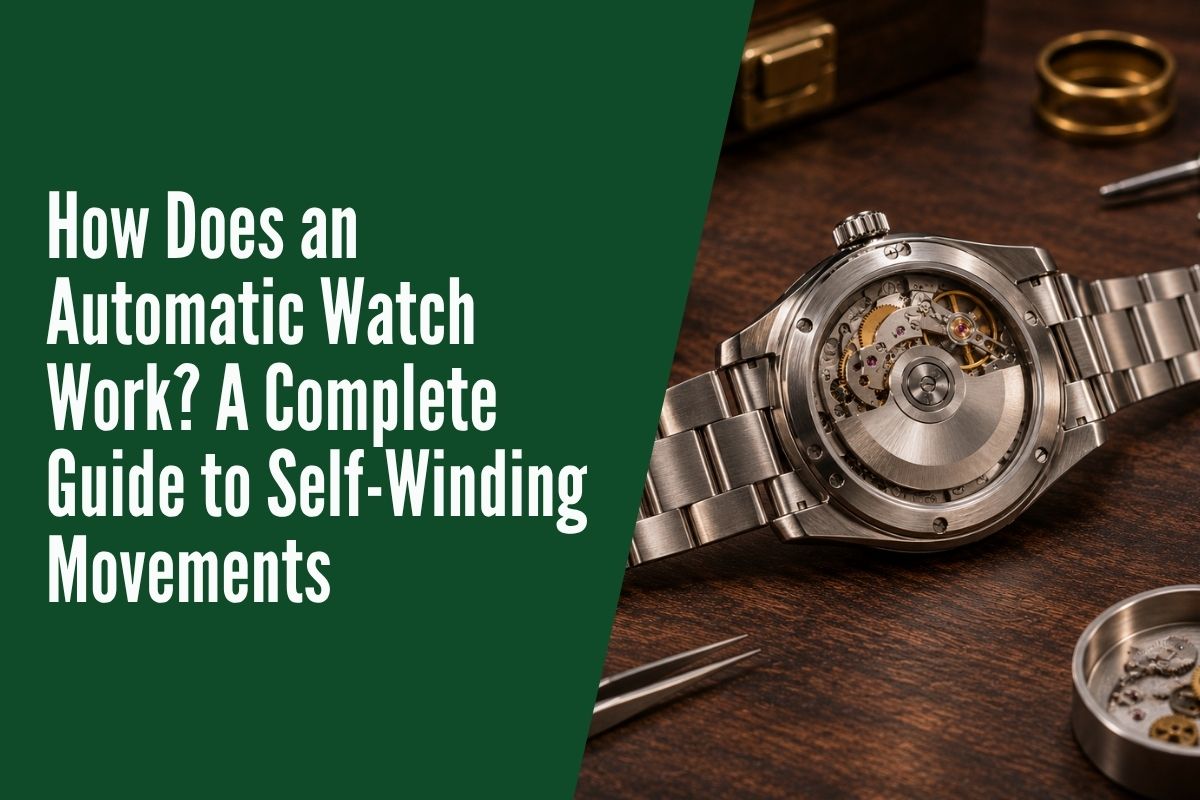
What if your watch could keep running without a battery, simply because you wear it? That is part of the appeal of automatic watches, where intricate engineering turns ordinary wrist movements into something remarkable.
From the Rolex Submariner to the Omega Seamaster, automatic movements have become a defining feature of many luxury timepieces. Yet, despite their popularity, the mechanism behind them remains a mystery to many first-time buyers.
So, what actually happens inside an automatic watch, and how does it continue ticking even after you take it off? Let's uncover the fascinating mechanics behind these timepieces and what makes them worth owning.
What Is an Automatic Watch?
An automatic watch, also known as a self-winding watch, is a mechanical timepiece that uses the natural movement of your wrist to wind its internal mainspring. Unlike a battery-powered watch, it relies entirely on mechanical energy to keep time.
To understand how it differs from other watches, it helps to know the three main terms:
- Mechanical watch: A broad category of watches that use energy stored in a wound mainspring.
- Manual mechanical watch: Requires you to wind the mainspring by turning the crown.
- Automatic mechanical watch: Uses wrist movement to wind the mainspring, although many modern models also allow manual winding through the crown.
Every conventional automatic watch is mechanical, but not every mechanical watch is automatic.
The key difference lies in how the mainspring receives energy. An automatic movement uses a winding mechanism to replenish it, while the stored energy drives the watch's timekeeping components.
How Does an Automatic Watch Work?
An automatic watch works by capturing energy from your wrist movements and storing it inside a mechanical spring. That energy passes through a series of gears before the escapement and balance wheel regulate its release, allowing the hands to display the time accurately. Although the process involves several tiny components, each has a distinct purpose.
The sequence: Wrist movement → Rotor → Winding mechanism → Mainspring → Gear train → Escapement → Balance wheel → Watch hands.
1. Your Wrist Moves the Rotor
The process begins with the rotor, also called the oscillating weight or oscillating mass. This weighted component pivots around an axle inside the movement, responding to changes in your wrist's position.
As you walk or gesture, gravity and inertia cause the rotor to move relative to the watch. Depending on your movements, it may swing backwards and forwards or complete full rotations.
Some automatic watches have a transparent exhibition caseback, allowing you to observe the rotor moving. It is usually the large, semicircular component visible behind the movement.
2. The Automatic Winding Mechanism Transfers the Rotor's Motion
The rotor cannot wind the mainspring directly. Its irregular movements must first pass through an automatic winding mechanism, which converts them into controlled rotation.
Depending on the calibre, this system can include reduction gears, reversing wheels, transmission wheels or specialised levers. These components help transfer energy efficiently while ensuring the mainspring winds in the correct direction.
Different Automatic Winding Systems
Watchmakers have developed several solutions to achieve this:
- Rolex Perpetual System: Uses reversing wheels that allow the rotor to contribute to winding in either rotational direction.
- Seiko Magic Lever: Employs a lever with two pawls that alternately push and pull a transmission wheel, transferring motion from both rotor directions.
- IWC Pellaton System: Uses an eccentric cam and rocking bar with pawls to convert rotor movement into winding action.
Each system performs the same essential function, although its construction and efficiency depend on the movement's engineering.
3. The Mainspring Stores the Energy
Once the winding mechanism receives the rotor's movement, it winds the mainspring, a long, thin strip of metal coiled inside a cylindrical container called the mainspring barrel.
Winding increases the energy stored in the spring. As it gradually unwinds, the spring releases mechanical energy that drives the watch.
Think of the rotor and winding mechanism as the charging system, while the mainspring acts as the energy reservoir.
Because the energy remains stored, your automatic watch can continue running after you remove it from your wrist. How long it lasts depends on its available power reserve.
4. The Gear Train Carries Energy Through the Movement
Energy leaving the mainspring causes the barrel to rotate, driving a connected series of wheels and pinions known as the gear train or going train.
These precisely arranged gears transmit power through the movement while producing the different rotational speeds required for timekeeping.
However, the mainspring naturally wants to unwind much faster than a watch should run. Without a mechanism controlling its release, the movement could not maintain consistent time.
5. The Escapement Controls the Release of Energy
The escapement manages the transfer of energy from the gear train to the watch's regulating system.
In a conventional Swiss lever escapement, the escape wheel interacts with a pallet fork fitted with small synthetic ruby jewels.
Rather than allowing the gears to rotate freely, the pallet fork repeatedly locks and unlocks the escape wheel. Each cycle permits a small amount of movement and supplies an impulse that helps sustain the balance wheel's oscillation.
This interaction creates the familiar ticking sound associated with mechanical watches.
6. The Balance Wheel and Hairspring Regulate Time
At the heart of the watch's precision sits the balance wheel, which oscillates in alternating directions.
Attached to it is a delicate spiral called the hairspring or balance spring. It provides the restoring force that returns the wheel towards its central position.
Together, these components establish the movement's timing rhythm, while the escapement maintains their oscillation.
Watchmakers describe this rhythm using frequency or vibrations per hour:
- 21,600 vibrations per hour: 3 Hz
- 28,800 vibrations per hour: 4 Hz
Both are common mechanical movement frequencies, but higher frequency does not automatically guarantee better accuracy. Movement construction, adjustment, friction and energy consumption also influence performance.
7. The Movement Drives the Watch Hands
The final stage converts regulated mechanical motion into the time you read on the dial.
The gear train drives the seconds indication, where fitted, while components known as the motion works establish the appropriate relationship between the minute and hour hands.
Consequently, the hands advance at their required speeds rather than following the rotor's irregular movements.
Your wrist keeps replenishing the mainspring's energy, while the escapement and balance regulate its release. Together, these mechanisms allow an automatic watch to maintain time through an entirely mechanical process.
What Happens When an Automatic Watch Is Fully Wound?
An automatic watch continues responding to wrist movements even after its mainspring reaches full tension. To prevent excessive winding, most modern automatic movements use a protective feature called a slipping bridle.
This small component sits at the outer end of the mainspring and presses against the inside wall of the mainspring barrel. Once the spring reaches its intended tension, the bridle slips along the barrel wall, preventing further increases in stored energy.
The rotor can therefore continue moving as you wear your watch without placing excessive tension on the mainspring.
Although this mechanism protects against overwinding during normal use, its design varies between calibres. Modern automatic watches are generally built to manage continuous winding safely, but mechanical faults or improper handling can still cause damage. Following the manufacturer's winding instructions remains important, particularly for older or unusual movements.
How Long Does an Automatic Watch Run Without Being Worn?
An automatic watch continues running after you remove it from your wrist, using the energy already stored in its mainspring. The length of time it can operate without further winding is known as its power reserve.
Many modern automatic watches offer around 40 to 80 hours of power reserve, although some luxury movements can run considerably longer. The exact duration depends on the calibre.
For example:
- Seiko 4R35 and 4R36: Offer approximately 41 hours of power reserve.
- Rolex calibres 2236 and 3235: Provide approximately 55 and 70 hours of running time, respectively.
- IWC calibre 32110: Delivers approximately 72 hours of power reserve.
A fully wound watch with a 70-hour reserve could still be running on Monday if removed on Friday evening. However, actual running time depends on how much energy was stored when you took it off.
When comparing automatic watches, check the power reserve of the exact movement rather than assuming every model offers the same duration.
Can You Manually Wind an Automatic Watch?
Most modern automatic watches allow you to wind the mainspring manually by turning the crown. Although wrist movement normally keeps the watch running, manual winding helps restore its power reserve when the movement has stopped or your daily activity provides insufficient motion.
For example, Rolex recommends manually winding a stopped watch before wearing it, while Seiko's 4R35 and 4R36 movements also support winding through the crown.
The number of crown turns required varies between calibres, so a fixed winding routine will not suit every automatic watch. Some older movements, including Seiko's 7S26, lack manual winding entirely and rely on rotor movement.
A gentle movement of your wrist can help start certain stopped watches, but vigorous shaking is unnecessary. For models with a screw-down crown, remember to secure it after winding.
Always check your watch's movement instructions before winding it manually.
Why Does an Automatic Watch Have a Sweeping Second Hand?
The seconds hand on an automatic watch appears to glide around the dial rather than jump once every second, as it does on most quartz watches. However, this motion is not perfectly continuous.
Its smooth appearance comes from the movement's beat rate, which determines how frequently the escapement releases the gear train.
- 21,600 vibrations per hour (vph): 6 steps per second.
- 28,800 vibrations per hour (vph): 8 steps per second.
These rapid movements become difficult to distinguish at normal viewing distance, creating the familiar sweeping appearance.
Importantly, the effect comes from the mechanical timekeeping system, not the automatic winding mechanism. Manual mechanical watches can produce the same motion.
What Automatic Watch Specifications Actually Mean
When comparing automatic watches, you will come across technical specifications that reveal more about a movement than its appearance. Understanding these details helps you assess a watch's performance, mechanical construction, and suitability for everyday wear.
Among these specifications, the calibre deserves particular attention when buying a luxury automatic watch. Even models from the same manufacturer can contain different movements with varying performance characteristics and maintenance requirements.
What Should You Know Before Buying an Automatic Watch?
Choosing an automatic watch involves more than finding a design you like. The movement's condition, operating characteristics, and suitability for your routine can influence how satisfied you are with your purchase.
- Consider your wearing habits: If you alternate between several watches, choose a model that accommodates your routine. A watch worn occasionally may need more frequent time and date adjustments.
- Research the specific movement: Look beyond the brand name and investigate the calibre's reputation, serviceability, and any known mechanical concerns associated with that reference.
- Check timekeeping performance: Compare the watch's measured accuracy with the manufacturer's specifications. When buying a pre-owned model, ask whether its performance has been tested recently.
- Test the winding mechanism: Check that the crown operates smoothly where manual winding is supported. Unusual resistance, grinding sensations or inconsistent winding behaviour may warrant professional inspection.
- Review the service history: Request available maintenance records and establish whether previous repairs involved genuine or manufacturer-approved components. A recently serviced watch can still benefit from an independent condition assessment.
- Examine the movement where possible: An exhibition caseback allows you to appreciate the mechanical construction and finishing, although visible decoration alone cannot establish movement quality.
Before purchasing a pre-owned Rolex, Omega or another luxury automatic watch, consider having its movement assessed by a qualified watchmaker. A watch's external condition does not necessarily reflect the health of its internal mechanism.
Do Automatic Watches Need a Watch Winder?
Most automatic watches do not need a watch winder to remain in good working condition. Leaving your watch unworn until its power reserve runs out is generally harmless, provided you follow the manufacturer's care recommendations.
A watch winder is a device that gently rotates an automatic watch to simulate wrist movement. It can be useful for collectors who regularly switch between timepieces, particularly those with perpetual calendars or other complications that require careful resetting.
However, a winder is not essential for everyday models. If your watch stops, you can usually wind it manually, where supported, set the correct time and resume wearing it.
When choosing a winder, check your movement's recommended turns per day (TPD) and winding direction. These requirements vary between calibres, and unnecessary continuous winding can contribute to wear.
Ultimately, a watch winder offers convenience rather than being a requirement for maintaining an automatic watch.
Finding the Right Automatic Watch for You
An automatic watch offers something that quartz technology cannot quite replicate: the experience of wearing a timepiece powered by intricate mechanical engineering. Its craftsmanship, heritage and connection to traditional watchmaking continue to attract enthusiasts and collectors.
Choosing the right model requires more than appreciating its design. Understanding the calibre, winding system, power reserve, and service history can help you make a more informed purchase.
At Time Is Money Watches, we help you explore luxury automatic watches from Rolex, Omega, TAG Heuer, Audemars Piguet and Patek Philippe. Whether you want to compare available models, source a particular reference, or arrange professional servicing, our team can guide you through your options.
Browse our luxury watch collection or contact us to find an automatic timepiece that suits your preferences.
FAQs
Does an automatic watch need a battery?
No. A conventional automatic mechanical watch does not use a battery. However, not every watch described as automatic operates entirely mechanically. Certain hybrid technologies, such as Seiko Kinetic, use a moving rotor to generate electricity that is stored in a rechargeable power source. When purchasing a watch, check whether the movement is mechanical, quartz or a hybrid system. These distinctions affect maintenance, accuracy and how the watch operates.
How long do you have to wear an automatic watch to wind it?
Wearing an automatic watch for eight hours does not guarantee that it will become fully wound. Your activity level matters, particularly if you spend much of the day sitting. Some Seiko automatic movements recommend more than ten hours of daily wear to maintain sufficient winding. Other calibres have different requirements. If you lead a relatively sedentary lifestyle, manual winding before wearing the watch may help maintain a more consistent reserve.
Why does my automatic watch stop overnight?
An automatic watch that repeatedly stops overnight may have insufficient stored energy or an underlying mechanical problem. Before arranging repairs, establish whether it has received adequate winding. If the movement supports manual winding, follow its instructions to wind the watch sufficiently, then leave it stationary and measure how long it operates. A substantially shorter running time than expected may indicate a problem with the winding system, mainspring or movement condition. A qualified watchmaker can investigate recurring failures.
How accurate is an automatic watch?
Automatic watch accuracy depends on the calibre and its regulation. For example, Seiko's 6R55 calibre has a stated factory accuracy range of 15 seconds slow to 25 seconds fast per day under specified conditions. Other movements have considerably tighter tolerances. To assess your watch, compare its time against a reliable reference over seven to ten days and calculate the average daily difference. A consistent gain or loss outside the manufacturer's expected performance may warrant professional regulation.
Is it bad to let an automatic watch stop?
No. Occasional stopping does not normally damage a healthy automatic movement. However, certain watches require extra attention when restarting. Models with date displays, moon phases or perpetual calendars may have specific setting procedures and restricted adjustment periods. Forcing a calendar correction while its mechanism is engaged can damage components in some calibres. Consult the watch's operating instructions before making adjustments, especially if the timepiece has been unworn for several days.
Do automatic watches need servicing?
Yes, but the appropriate servicing interval depends on the manufacturer, movement and usage. For example, Rolex recommends servicing approximately every ten years for many of its watches, while Seiko recommends shorter intervals for various mechanical models. A service may involve dismantling and cleaning the movement, renewing lubricants, inspecting worn components and checking accuracy and water resistance. If your watch develops unusual winding resistance, condensation beneath the crystal or a sudden change in timekeeping, arrange an inspection rather than waiting for its next scheduled service.