What Happens During a Watch Service? A Complete Guide for Luxury Watch Owners
Your watch does not suddenly fail. It slowly slips.
A few seconds lost over a week. A winding action that feels slightly different. Nothing dramatic. Nothing urgent. Yet inside, metal meets metal thousands of times a day. Oils age. Seals harden. Tolerances shift by fractions you cannot see.
From the outside, everything looks fine. That is what makes servicing easy to ignore.
What actually happens once your watch leaves your wrist and reaches a professional bench is far more involved than most owners imagine.
Let’s take a closer look.
What Is a Watch Service?
A watch service is the complete dismantling and rebuilding of your watch movement.
Every wheel, spring, and pivot comes out. Old oil is removed because it no longer protects the surfaces it once did. Each part is examined under magnification to check whether wear has begun to alter its shape or tolerance. Components that no longer meet specification are replaced. The movement is then reassembled and lubricated with measured precision. Once cased again, the watch is regulated and tested to confirm accuracy and water resistance.
This is not cosmetic work. It does not exist to make your watch look better. It exists to prevent internal wear from becoming irreversible damage. Servicing is maintenance in its truest sense. It keeps a mechanical system healthy long before failure forces your hand.
Let’s see what happens at each stage once your watch reaches the watch service.
Step 1: Initial Assessment and Diagnostic Testing
Before the movement is opened, the watch is studied as it stands.
A mechanical watch tells you a great deal without being dismantled. How it runs, how it responds to pressure, and how it presents externally all point to what may be happening inside.
The first stage focuses on gathering that information.
1. Owner Consultation and Physical Review
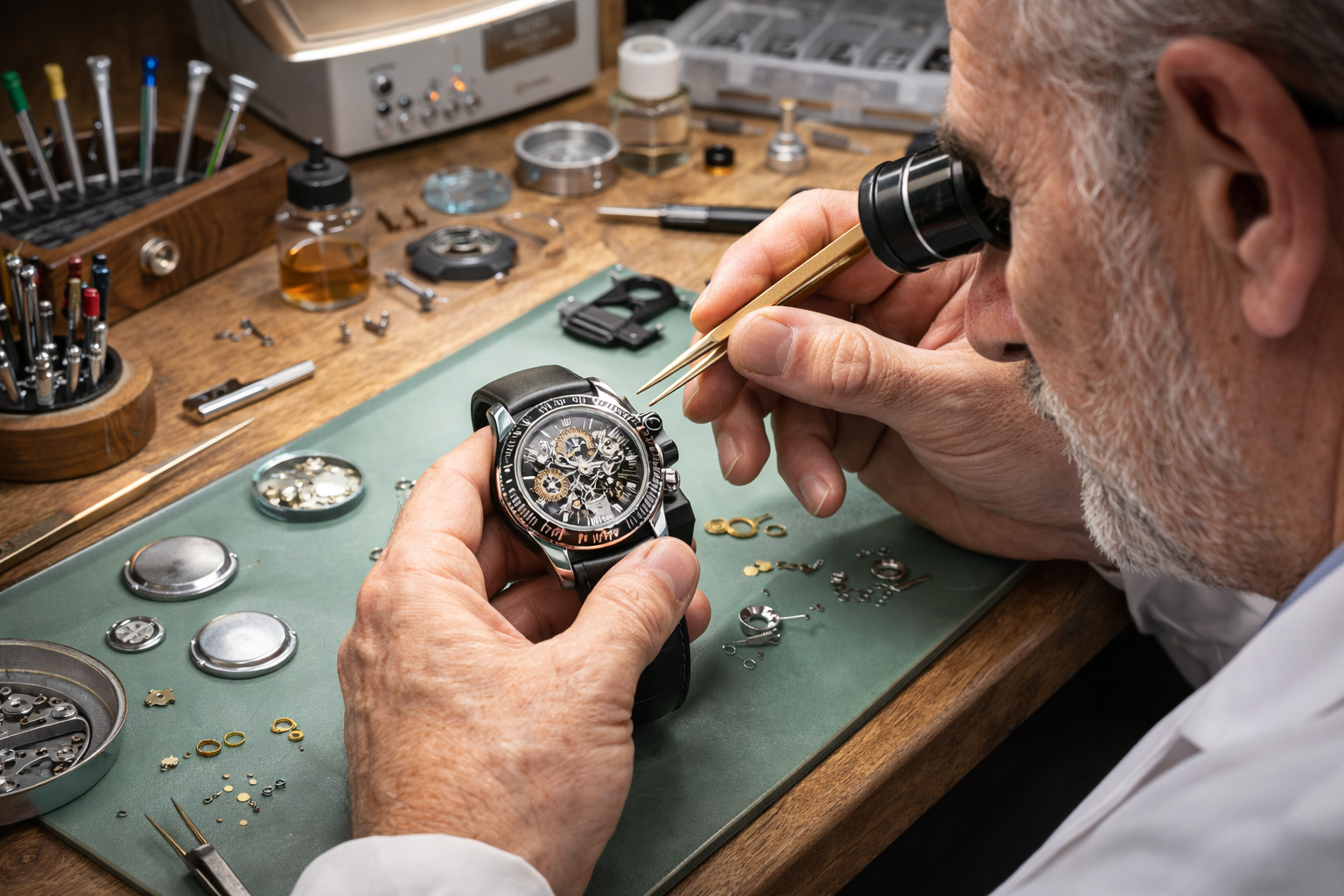
The watchmaker reviews previous service records and listens to the issues you have observed. The watch may be losing several minutes each week. The power reserve may no longer last overnight. If the watch has been exposed to water, this is noted immediately.
The case, crystal, crown, pushers, and bracelet are examined closely. Scratches are not the priority here. Structural concerns are. Any dents near the case back or crown tube are documented because they can affect sealing and alignment later in the process.
At Time Is Money Watches, this documentation is completed before approval is given to proceed, so you have clarity on the condition and likely scope before internal work begins.
2. Performance Testing

The watch is then placed on a timegrapher. This device measures:
- Rate deviation
- Amplitude
- Beat error
Readings are taken in multiple positions. A healthy movement should perform consistently whether dialing up, dialing down, or crowning down. Significant variation often indicates lubrication breakdown or localized wear in specific areas.
For example, low amplitude can indicate that the mainspring is no longer delivering sufficient power or that friction has increased within the gear train.
3. Water Resistance Testing

The watch is subjected to controlled air pressure to assess seal integrity. Even if you have never taken the watch swimming, gaskets age naturally. A failed test does not always mean internal damage, but it does confirm that the seals require replacement during service.
This diagnostic stage determines whether the watch requires only routine servicing or whether additional corrective work is required.
This is important so that the watch can be dismantled with a clear objective.
Step 2: Complete Disassembly of the Watch
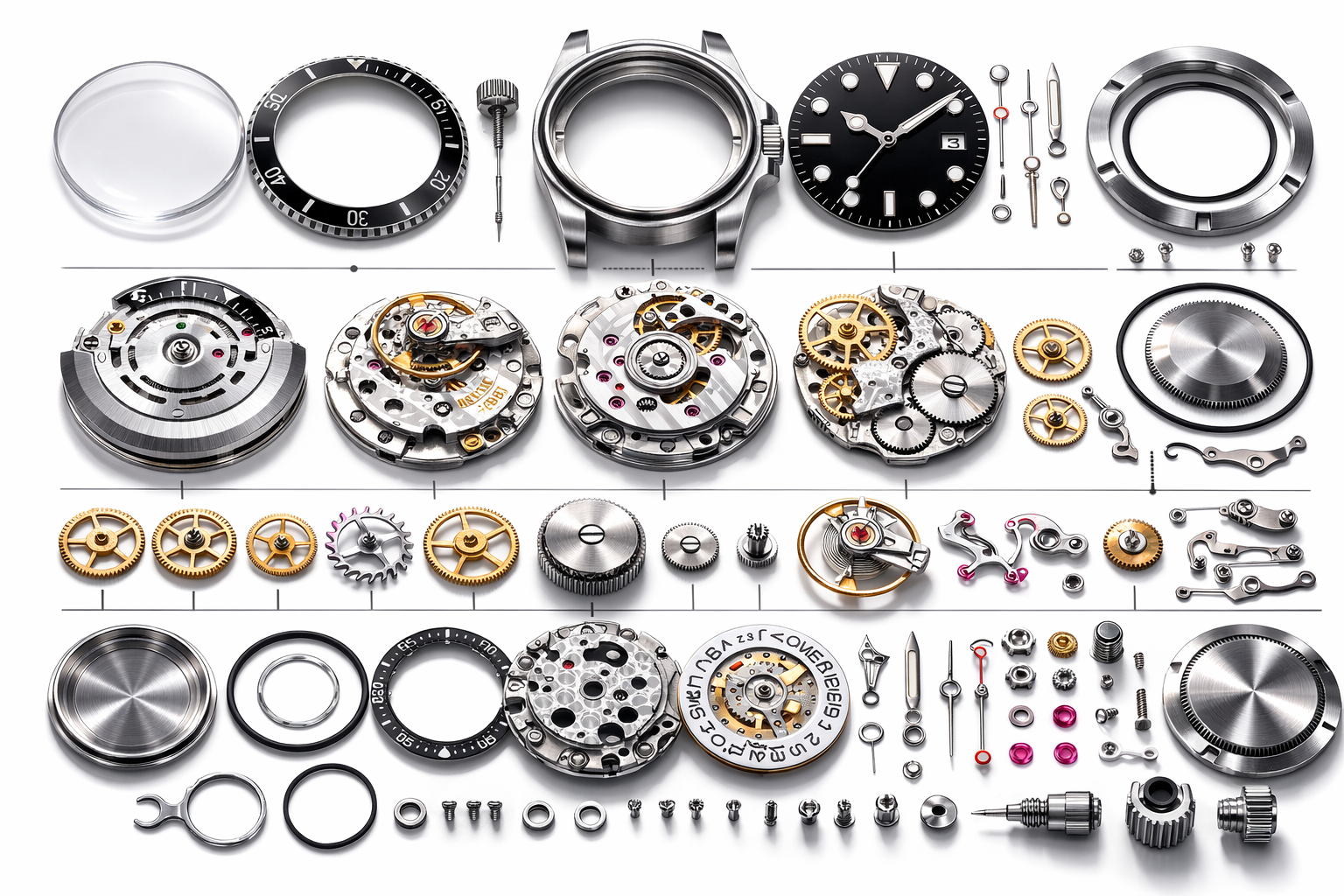
After testing confirms the scope of work, the watch is opened and reduced to its individual working components. A proper service does not involve partial access. The watch is stripped completely so every working surface can be cleaned, checked, and restored without assumption.
The disassembly follows a strict order:
- The case back is removed using the correct tool for the model to avoid damage to the case or threads
- The crown and stem are disengaged, allowing the movement to be lifted out safely
- The hands are removed with protective tools to prevent marking the dial
- The dial is separated, exposing the motion works beneath
Once access is clear, the internal assembly is taken apart piece by piece:
- Bridges are lifted and wheels removed in sequence
- The escapement, balance assembly, and mainspring barrel are dismantled
- Components are placed into organised trays to prevent contamination or loss
Each part is then examined under magnification for wear, corrosion, distortion, or fine fractures. Any component that no longer seems usable is marked for replacement.
Step 3: Ultrasonic Cleaning of Components
Once everything has been taken apart and inspected, cleaning begins. It is not a quick rinse. It is controlled and methodical because any residue left behind will compromise the rebuild.
The separated parts are placed into specialised baskets that keep them secure during washing. These baskets go into ultrasonic cleaning machines. High-frequency vibrations pass through a cleaning solution, loosening hardened oil and lifting away microscopic debris from surfaces that cannot be reached by hand.
Here’s the process:
- Initial ultrasonic bath to dissolve and remove old lubricants
- Secondary rinse cycles to flush away remaining particles and cleaning solution
- Additional cleaning, where required, for heavily soiled components
- Steam cleaning, in some cases, to ensure final purity
It’s really important to remove old lubricant. If fresh oil is applied over a degraded one, the residue increases friction and accelerates wear. Proper cleaning ensures that when the watch is rebuilt, lubrication performs exactly as intended rather than fighting against contamination from the past.
Step 4: Replacement of Worn Parts
Not every service requires part replacement, but it is common to find components that have worn beyond acceptable limits.
Some parts are replaced routinely because they naturally degrade with time. Others are changed only when inspection shows measurable wear.
Components often replaced during a full service include:
- Mainsprings that have lost tension
- Gaskets and seals that no longer provide reliable moisture protection
- Crown tubes affected by wear from repeated winding and setting
- Wheels or pivots showing surface wear
- Damaged or distorted screws
Replacing these parts is not about looks or about making the watch new, it is for restoring proper function and preventing premature strain on adjacent components.
For high-end brands, using genuine manufacturer parts is critical. Authentic components maintain mechanical integrity and protect long-term value. This is especially important with collectible pieces from houses such as Rolex, Patek Philippe, Audemars Piguet, and other luxury watches, where originality plays a significant role in resale and buyer confidence.
Step 5: Reassembly and Precise Lubrication
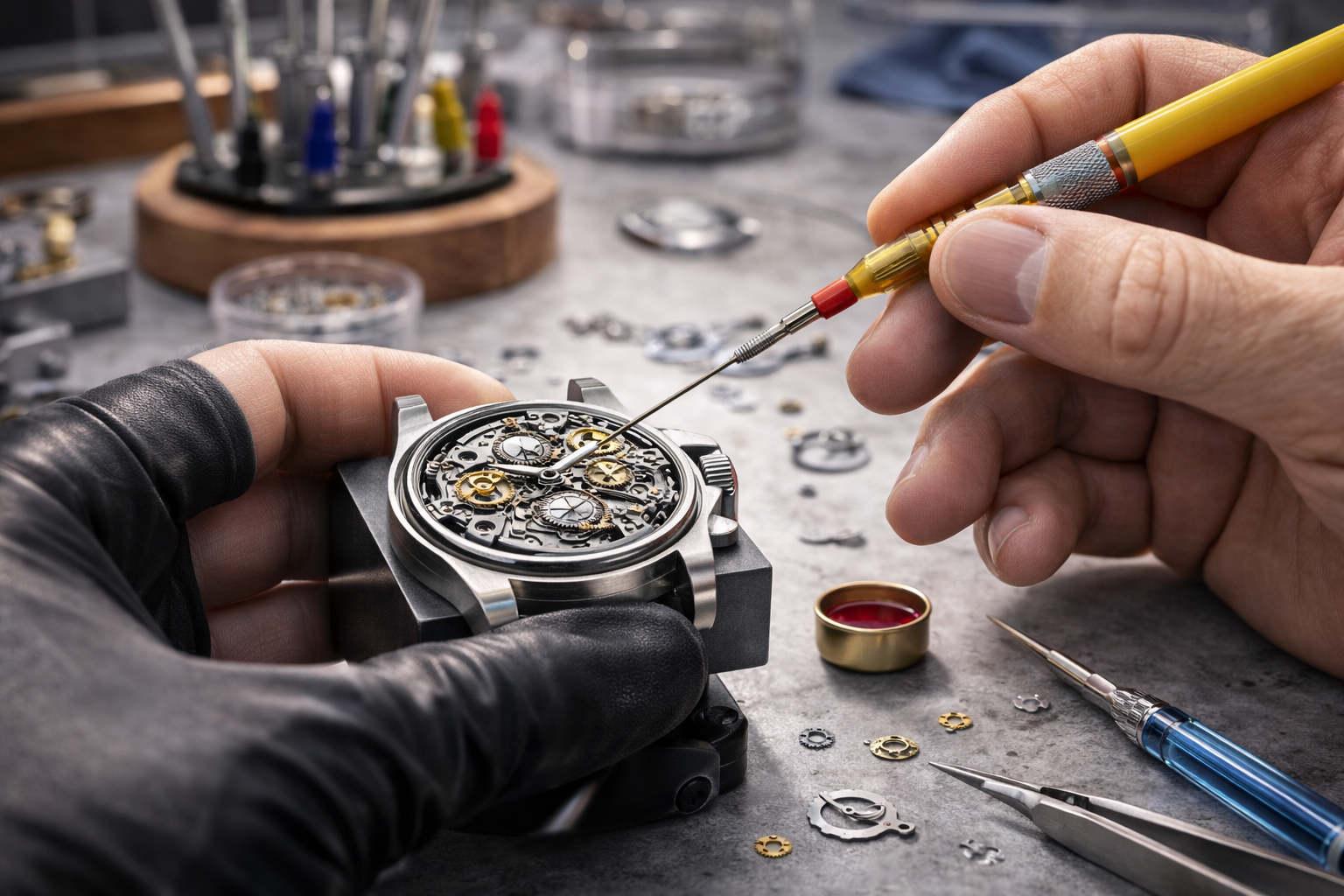
Watchmaker lubricating a mechanical watch movement during reassembly.
The rebuilding follows a strict internal order.
The wheel train is set back into place first. Each wheel must turn freely before anything is secured above it. If there is resistance here, it will only multiply later. The escapement is fitted next. Then the balance is positioned and adjusted. When those elements are correctly seated, the watch begins ticking again. That steady beat confirms the stored energy is moving through the system as it should.
Lubrication happens during this process, not once everything is closed. Oils are applied in quantities small enough to be barely visible. Different areas require different grades depending on speed and pressure. Too much oil spreads and interferes with performance. Too little increases wear. Precision in placement matters more than volume.
If the watch is automatic, the rotor is installed and checked to ensure it moves smoothly without friction.
Now the watch is live again.
Step 6: Regulation and Accuracy Adjustment
Regulation is not a single adjustment. It is a process of testing, correcting, and observing. The watch is measured on a timegrapher to assess daily rate, amplitude, and beat error. These readings show how efficiently energy moves through the system and whether the balance is oscillating evenly.
Testing is carried out in multiple positions. A watch does not sit flat all day. It rests on its side, crown up, crown down, dial up. Each position can influence performance slightly.
Adjustments are made so that timekeeping remains consistent across these variations and falls within the tolerances set by the brand.
Amplitude may be fine-tuned to ensure sufficient power delivery. Beat error is corrected so the balance swings evenly in both directions. Small changes here make measurable differences over time.
Regulation is not rushed. The watch is observed over several days to confirm stability. Only when performance remains consistent under repeated testing is the adjustment considered complete.
Step 7: Case Refinishing and Water Resistance Restoration
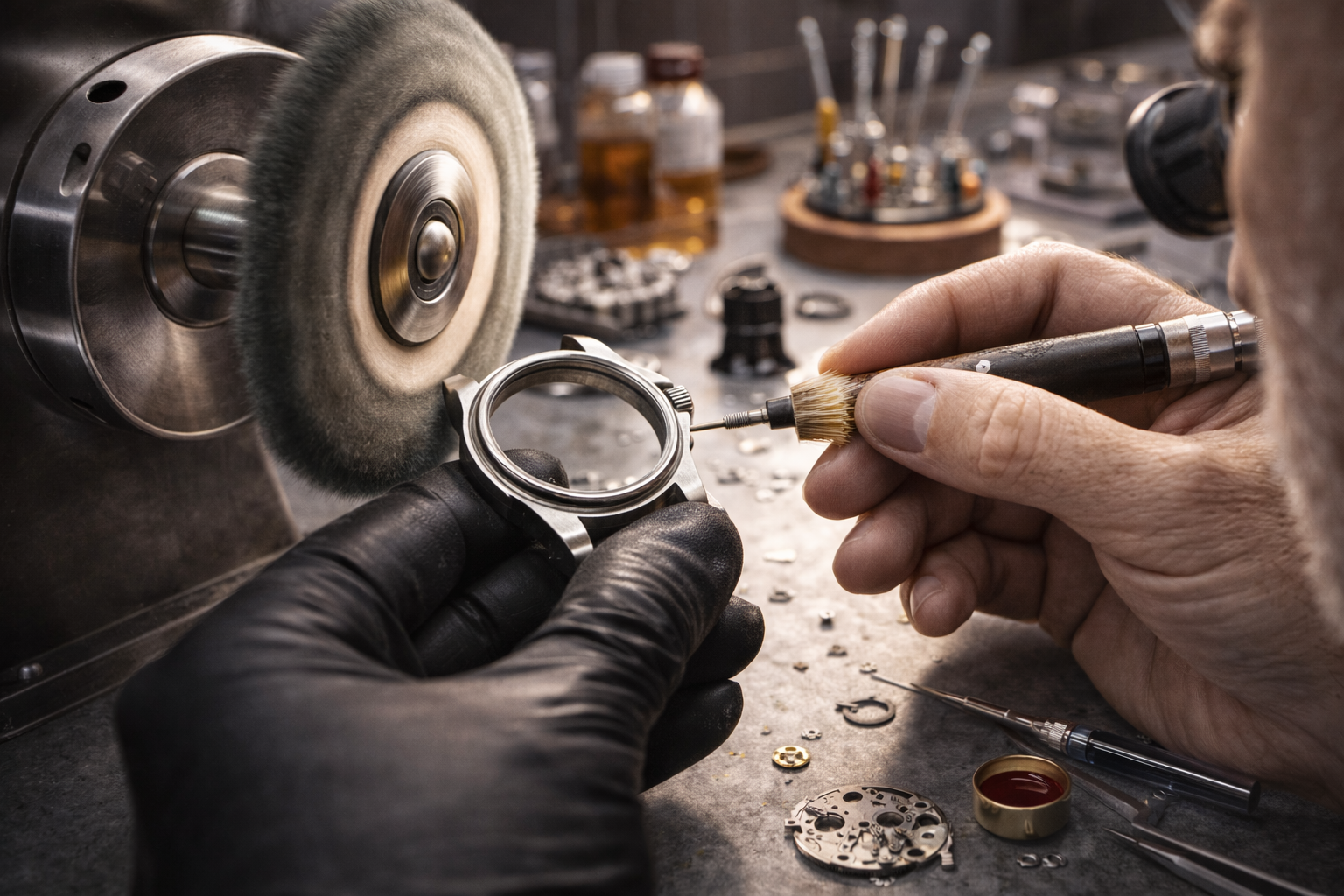
All gaskets are replaced as standard. That includes the case back seal, crown seals, and push button seals where present. These components degrade over time, even without visible exposure to water.
Once renewed, the case is pressure tested to confirm that moisture protection meets the specification. Water resistance is verified.
Only after sealing is confirmed does cosmetic work enter the discussion. Refinishing is optional and depends on your preference. Light surface wear can be reduced through careful polishing or brushing, but restraint matters. The original case lines, bevels, and proportions must remain intact.
Excessive polishing softens edges and alters the watch permanently, which is why many collectors choose to preserve original geometry rather than pursue a flawless surface.
When refinishing is requested, the goal is subtle improvement, and not transformation. The watch retains its character while appearing properly maintained.
Once sealing and any agreed cosmetic work are complete, the watch moves to final inspection before return.
Step 8: Final Quality Control
Timing is monitored again over several days to confirm consistency, not just a single strong reading. Daily rate is recorded across positions to ensure stability. Power reserve is measured to verify that the mainspring delivers energy for the expected duration. Water resistance is tested once more after sealing and casing to confirm that protection remains intact.
Every functional element is checked individually. The date must change cleanly at the correct interval. Chronograph pushers must engage and reset without hesitation. Manual winding should feel smooth and even. Nothing is assumed to work because it worked before disassembly.
A service report typically accompanies the watch, outlining the work carried out and any components replaced. This provides transparency and becomes part of the watch’s documented history.
At Time Is Money Watches, each serviced piece undergoes a final in-house inspection before it leaves the workshop. Whether collected from the showroom or dispatched securely, the watch is only returned once performance and function have been fully verified.
How Long Does a Watch Service Take?
There is no flat rate for servicing a luxury watch. The price reflects what is inside the case and what condition it is in when it arrives.
A simple time-only mechanical watch is very different from a chronograph or calendar model. Brand also matters. Some manufacturers make parts easy to source. Others require specialist ordering or manufacturer supply. If worn components need replacing, that changes the cost again.
In the UK, typical ranges look like this:
- Entry-level mechanical service: £120 to £300
- Mid-range Swiss brands: £400 to £800
- High complication or prestige brands: £1,000 to £2,000 and above
A complex piece from Richard Mille or a high-complication model from Patek Philippe will naturally sit at the higher end due to the construction and parts involved.
The only reliable way to know the exact figure is to have the watch assessed. You can request a quotation directly through the contact page, where the team can review your model and advise accordingly.
How Often Should You Service a Luxury Watch?
Most owners delay servicing because the watch still runs. If it keeps time and feels fine on the wrist, it is easy to assume nothing is wrong. The reality is less obvious. Wear happens gradually, long before performance drops sharply.
For a mechanical watch in regular use, 3-5 years is a sensible window. If you wear it daily, expose it to water, or rely on it as your primary timepiece, staying closer to 3 years reduces the risk of internal wear building up unnoticed.
If the watch is rotated with others and worn occasionally, the interval can extend beyond five years. Reduced use slows deterioration, though it does not eliminate it. Oils age even when the watch spends time in storage.
More important than the calendar are the changes you may notice:
- It starts gaining or losing time beyond what it once did
- The power reserve no longer lasts through the night
- Moisture appears beneath the crystal
- Winding feels uneven or slightly rough
Why Professional Servicing Protects Long-Term Value
Watches that are maintained properly behave differently in the market. Buyers look for evidence of care, not just appearance.
Routine servicing limits wear before it turns into permanent damage. Replacing seals on time prevents moisture issues. Renewing lubrication prevents unnecessary strain on components that are expensive to correct later. It is controlled upkeep rather than reactive repair.
When you decide to sell or upgrade, paperwork carries weight. Moving from a Datejust to a GMT, or stepping into a higher complication, is easier when the watch comes with a clear service record. It reduces negotiation and strengthens offers.
Condition and documentation travel together.
Time Is Money Watches works with collectors who expect both. Whether you are servicing a watch you plan to keep or preparing one for sale, the work is carried out with genuine parts and the level of care the secondary market demands.
FAQs
Is a watch service just cleaning the outside?
No. Cleaning the exterior is the smallest part of the process. A proper service focuses on the internal mechanics. The watch is taken apart, cleaned, inspected, lubricated, rebuilt, and tested for accuracy and water resistance. The aim is to restore performance, not simply improve appearance. Polishing the case does not address what is happening within the mechanism.
Will servicing remove all scratches?
Not automatically. Cosmetic refinishing is usually discussed separately and carried out conservatively. Light marks can be reduced, but preserving the original case shape matters more than chasing a flawless finish. Many owners prefer to keep factory edges sharp rather than risk over-polishing. The decision depends on your priorities and the watch itself.
Can I delay servicing if the watch still runs?
You can, but it is not always wise. A watch may keep reasonable time while lubrication has already begun to degrade. Friction builds gradually, by the time performance drops noticeably, internal wear may have progressed further than expected. Servicing earlier keeps maintenance predictable rather than corrective.
Does servicing increase resale value?
Servicing does not transform a watch into something it is not, but documentation helps. A recent, recorded service reduces uncertainty for the next buyer. It shows the watch has been maintained properly and supports confidence in its condition. That confidence often makes negotiations smoother, especially with higher-value pieces.