Keeping track of time becomes more interesting when your day involves more than one part of the world. You might be arranging meetings with overseas clients, checking international market hours, or finding the right moment to call family living abroad. A GMT watch makes these everyday situations easier to manage while adding a distinctive feature to your wrist.
But what is a GMT watch, and what makes it different from a regular timepiece? The answer involves more than an additional hand on the dial. Although GMT stands for Greenwich Mean Time, you can use the function to keep track of whichever second time zone matters to you.
Not all GMT watches operate in the same way, either. This guide explains how to read and set one, use it to track three time zones, understand the different GMT movements, and choose a watch that suits your needs.
What Is a GMT Watch?
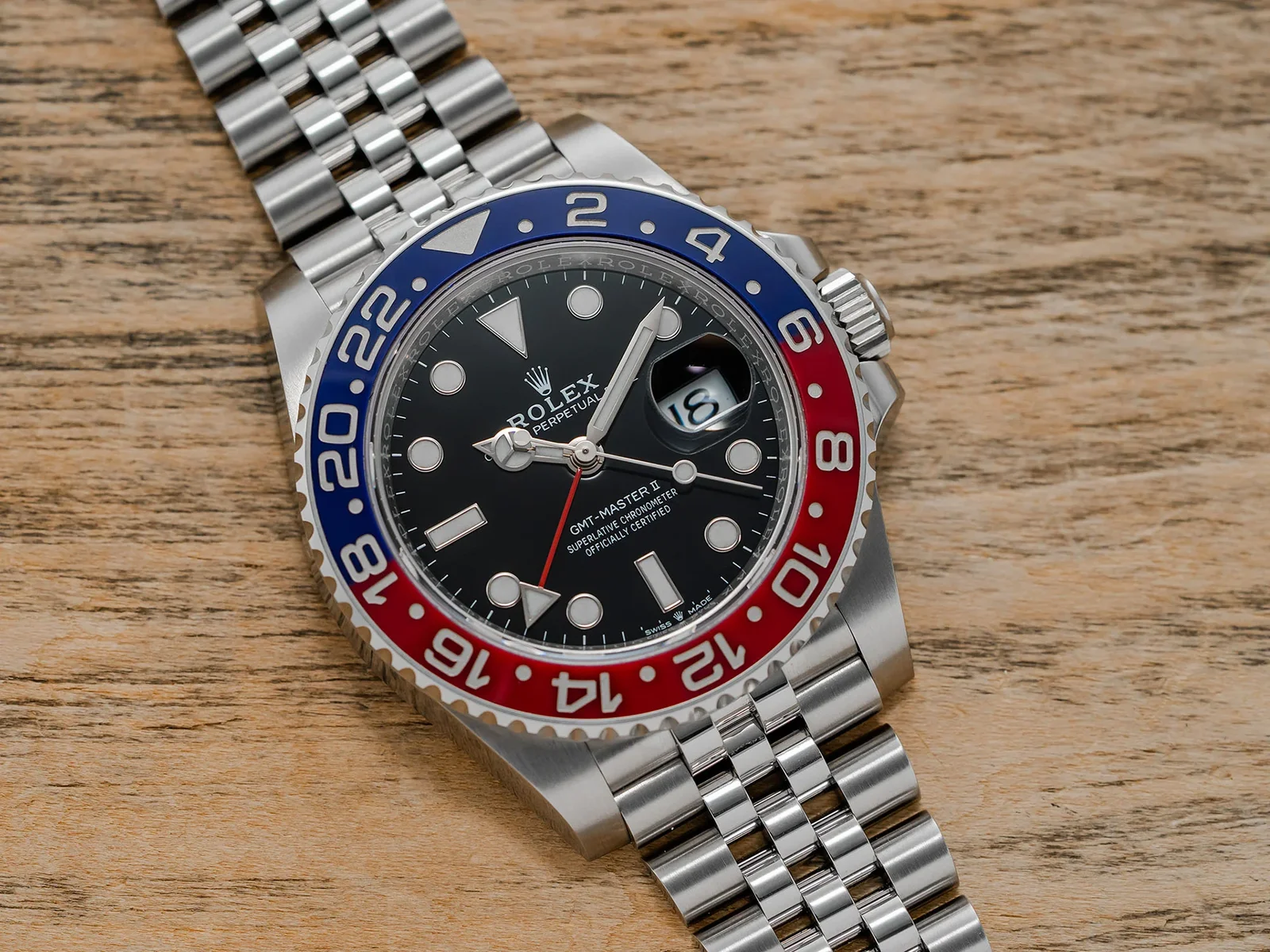
A GMT watch is a timepiece that displays at least two time zones simultaneously, allowing you to check the time in different locations without adjusting your watch.
Most GMT watches have three main components that make this possible:
- Standard hour and minute hands: Display the time in your primary location.
- GMT hand: An additional hand, often arrow-shaped or brightly coloured, that completes one full rotation every 24 hours.
- 24-hour scale: Marked on the bezel, dial or inner ring, allowing you to read the second time zone.
For example, your main hands might show 10:00 AM in London, while the GMT hand points to 05 on the 24-hour scale. This tells you it is 5:00 AM in your chosen second location. Both readings share the same minute hand.
The Rolex GMT Master II is a well-known example, featuring a separate GMT hand and a rotating 24-hour bezel.
What Does GMT Mean on a Watch?
GMT stands for Greenwich Mean Time, a timekeeping system originating at the Royal Observatory in Greenwich, London. It developed from observations of the Sun's average movement and is closely associated with the Prime Meridian, the reference line for measuring longitude worldwide.
Today, Coordinated Universal Time (UTC) serves as the international time standard, using atomic clocks for precise timekeeping. Although GMT has astronomical origins, both correspond closely enough for everyday wristwatch readings.
In modern watchmaking, GMT describes a time zone complication rather than a requirement to follow Greenwich time. You can set the additional hand to your home time, an overseas office, or another location you regularly monitor.
How Does a GMT Watch Work?
A GMT watch uses a movement that drives two hour indicators at different speeds. The regular hour hand completes a full rotation every 12 hours, while the GMT hand takes 24 hours to circle the dial.
This difference helps you distinguish between morning and evening in another location. A conventional 12-hour display showing 7 could mean either 7 AM or 7 PM. On the GMT watch's 24-hour scale, 07 indicates morning, while 19 indicates evening. You can check the time without making that distinction yourself.
The way you adjust these hands depends on the movement. Some watches, including the Rolex GMT Master II, allow you to change the local hour independently. Others let you adjust the GMT hand separately. These two mechanisms form the basis of traveller GMT and caller GMT watches, which we will examine next.
Traveller GMT vs Caller GMT: What Is the Difference?
Traveller GMT
A traveller GMT, also called a flyer GMT, travel GMT or true GMT, lets you adjust the regular hour hand independently, usually in one-hour increments. The GMT hand remains set to your chosen reference time.
Suppose you are travelling from the UK to Dubai. Before departure, your GMT hand displays UK time. Once you arrive, you can move the local hour hand forward by four hours during UK winter or three hours during British Summer Time. The minutes, seconds and reference time continue running without interruption.
On many traveller GMT watches, the date also moves forward or backward when the local hour hand crosses midnight.
The Rolex GMT Master II is a familiar example, particularly popular among frequent travellers and airline crew.
Although enthusiasts often use the term true GMT, it does not mean that other GMT mechanisms are less authentic.
Caller GMT
A caller GMT, also known as an office GMT, allows you to adjust the additional 24-hour hand independently while keeping your normal time display unchanged.
For example, suppose you work in Manchester and regularly communicate with colleagues in Tokyo. You can keep your main hands on UK time while setting the GMT hand to Japan Standard Time. This lets you check the working hours of your overseas team without calculating the time difference each time.
Caller GMT watches are particularly convenient for professionals managing international business, remote teams, overseas family connections or financial markets. If you spend most of your time in one country, this arrangement may suit you better than a traveller GMT.
The main limitation appears when you change your local time. On a typical caller GMT, adjusting the conventional time display also moves the GMT indication, which may then need correcting.
The following table summarises the practical differences:
Neither mechanism is inherently superior. The better GMT watch is the one that matches how you plan to use it, rather than the one with the more complicated movement.
How to Read a GMT Watch
Reading a GMT watch becomes simple once you understand how the hands work together. Follow these steps to check both time zones:
- Check the main hands: Read the regular hour and minute hands to determine your local time.
- Find the GMT hand: Look for the additional hand, often distinguished by a different colour or arrow-shaped tip.
- Read the 24-hour scale: Check the number indicated by the GMT hand to identify the hour in your second location.
- Add the minutes: Use the regular minute hand to complete the second time reading.
For example, if your main hands show 10:10 AM and the GMT hand points to 15, your second location is at 3:10 PM.
If your watch has a date window, remember that its date may follow the local or main time setting depending on the movement.
This example assumes the 24-hour bezel is in its normal position. On models with a rotating bezel, changing its position also changes the second time reading.
Can a GMT Watch Show Three Time Zones?
Yes, some GMT watches can track three time zones, provided they have a rotating 24-hour bezel. This feature lets you check an additional location without changing the watch's hands.
Here is how it works:
- First time zone: The conventional hour and minute hands display your current local time.
- Second time zone: With the bezel in its original position, the GMT hand indicates your chosen reference time.
- Third time zone: Rotate the bezel according to the hour difference between your reference location and the third destination. The GMT hand now points to the time in that location.
For example, the Rolex GMT Master II has a bidirectional rotating bezel that allows you to switch between a reference time and an alternative time zone.
There is one important limitation: the GMT Master II does not display all three times simultaneously. Turning its bezel replaces the second time zone reading with the third. You can restore the original reference time by returning the bezel to its starting position.
A watch with only a fixed 24-hour scale cannot make this adjustment. Some GMT models with both a fixed scale and rotating bezel can display three time zones at once.
Why Do GMT Watches Have Two Colour Bezels?
The two-colour bezel on a GMT watch originally served a practical purpose. Its contrasting halves help distinguish daytime from nighttime hours, making it easier to recognise whether it is morning or evening in another location.
The original Rolex GMT Master introduced in 1955 featured a red and blue bezel, with red representing daytime and blue indicating nighttime. This visual distinction made the 24-hour display easier to interpret.
Over time, these colour combinations became a defining feature of GMT watch design. Collectors now recognise several popular Rolex variations by their nicknames, including Pepsi (red and blue), Batman (blue and black), Coke (red and black) and Root Beer (brown and black).
Today, these distinctive bezels attract enthusiasts for their appearance and collectability, even when the GMT function sees little everyday use.
GMT Watch vs Dual Time vs World Timer
GMT, dual time and world timer watches all help you keep track of time in different locations, but they display that information differently. Dual time is the broader category, while GMT watches use a particular type of display. World timers serve a different purpose by providing a wider view of international time zones.
Here is how they compare:
Most GMT watches qualify as dual time watches, but not every dual time watch uses a conventional GMT display. A world timer is not automatically better than either option. Its usefulness depends on how many locations you need to monitor.
For a real example, the Patek Philippe World Time collection uses rotating city and 24-hour discs to display time across 24 reference zones. This makes it particularly useful when you need to check several international locations rather than just one overseas destination.
Is Every Watch With a 24 Hour Hand a GMT Watch?
No. Some watches feature an additional 24-hour hand that simply follows the regular hour hand, indicating whether it is AM or PM. This is different from a GMT complication, where the hands can display separate time references.
When comparing watches, check whether the additional hand can be adjusted independently or whether the local hour hand can move without changing the 24-hour reference. If neither is possible, the extra hand may only serve as a day and night indicator rather than a functional second time zone display.
A Brief History of the GMT Watch
Watches capable of displaying multiple time zones existed long before the modern GMT watch became popular. In 1908, Longines introduced a dual time pocket watch designed to display Turkish and Western time, followed by a patent in 1911. The brand later introduced its Zulu Time wristwatch in 1925, offering two time references on a single dial.
Aviation brought greater attention to these practical complications. The Glycine Airman, introduced in 1953, featured a 24-hour dial and rotating bezel. Rolex followed in 1955 with the GMT Master, developed in connection with the needs of international pilots and closely associated with Pan American World Airways.
The Rolex GMT Master helped establish the modern GMT watch design, although it was not the first watch to track multiple time zones. In 1982, Rolex introduced the GMT Master II, featuring an independently adjustable local hour hand that made changing time zones more convenient.
Is a GMT Watch Worth It?
A GMT watch is worth considering if you regularly travel internationally, work with overseas clients, or have family living abroad. It can also be useful for monitoring UTC, commonly called Zulu time in aviation. Having another time reference on your wrist saves you from repeatedly checking your phone.
Of course, a smartphone can display numerous world clocks and automatically account for time changes. A mechanical GMT offers a different experience, combining practical functionality with traditional watchmaking. Its aviation heritage, distinctive bezel designs and additional hand also appeal to collectors who appreciate the craftsmanship and appearance of luxury watches.
There’s a downside, though: you will also need to adjust the watch manually when daylight saving time begins or ends, as GMT watches do not account for these changes automatically.
Whether a GMT watch is worth buying depends on how much you value its functionality, design, and mechanical character.
What Should You Look for When Buying a GMT Watch?
When buying a GMT watch, consider how easily you can read and operate it, along with its comfort and long-term maintenance needs. A watch may have impressive specifications but still feel inconvenient during everyday use.
Here are a few things worth checking before making your decision:
- Ease of adjustment: Try operating the crown and bezel. The different setting positions should feel distinct, and the hands should respond precisely without excessive play.
- Dial readability: Check whether you can identify the GMT hand quickly. Crowded hour markers, small numerals or poor colour contrast can make the additional time display difficult to read.
- Movement and power reserve: Research the calibre's service requirements, availability of replacement parts and expected running reserve. These considerations become particularly important when buying a discontinued luxury watch.
- Case dimensions and comfort: Look beyond the advertised diameter. Case thickness, lug length, weight and bracelet adjustment can significantly affect how a watch feels on your wrist.
- Fractional time zones: If you frequently track India (UTC +5:30) or Nepal (UTC +5:45), check whether the watch can accommodate these offsets accurately. Many mechanical GMT movements use whole-hour adjustments, making such differences less convenient to display.
For a pre-owned GMT watch, inspect the condition of the case and bracelet, confirm its authenticity and review any available service records. It is also worth testing the crown, bezel, and calendar functions before purchasing.
Choosing a GMT Watch That Works for You
The best GMT watch is one that suits how you use it. Whether you prefer the convenience of a traveller GMT, the functionality of a caller GMT, or the distinctive design of a rotating bezel, your choice should reflect your lifestyle and personal taste.
At Time Is Money Watches, we help you find luxury timepieces that meet your preferences and expectations. We buy, sell, source and service watches from prestigious brands, including Rolex, Patek Philippe, Audemars Piguet, Omega, Cartier, TAG Heuer and Richard Mille.
You can visit our Hale showroom to explore available watches, discuss different GMT configurations and try on a model before purchasing. If you have a particular reference in mind, our specialist sourcing service can help you find it.
We also offer part exchange if you are considering trading your existing luxury watch for a GMT model.
Contact Time Is Money Watches to discuss your requirements and explore your options with confidence.
FAQs
What is the purpose of a GMT watch?
A GMT watch helps you make better decisions about timing when dealing with people in different countries. For example, you can check whether an overseas business is likely to be open before making a call. The 24-hour indication also removes confusion between morning and evening, which can be particularly helpful when planning international communication.
What is a true GMT watch?
A true GMT is another name for a traveller GMT, but the terminology can be misleading. It does not indicate superior accuracy, construction quality or certification. A caller GMT from a reputable manufacturer can be just as reliable. When comparing watches, focus on how the movement operates and whether its adjustment system suits your requirements.
Does a GMT watch have to show Greenwich Mean Time?
No. You can choose any suitable reference location, provided the watch allows the required time difference to be represented. Some people prefer to keep their GMT hand on a fixed reference throughout the year, while others change it depending on their schedule. Remember that locations observing daylight saving time may require seasonal adjustments.
What is the difference between GMT and UTC?
GMT developed from astronomical timekeeping, while UTC relies on atomic timekeeping combined with occasional leap seconds to remain close to Earth's rotation. Both share the same nominal time offset, UTC+00:00. An important distinction is that GMT also remains a civil time designation in some contexts, whereas UTC provides the standard reference for international time coordination.
Are GMT watches only useful for travellers?
No. GMT watches are also popular among collectors who appreciate their aviation connections and distinctive designs. You might choose one for its colourful bezel, movement engineering or historical significance without regularly consulting the additional hand. The complication adds character to the watch even when you use it primarily to tell local time.
What is the difference between a GMT watch and a world timer?
The distinction becomes important when comparing actual watches. A conventional GMT lets you concentrate on selected locations, whereas a world timer typically uses a city ring to provide a broader international overview. Many mechanical world timers represent 24 standard whole hour offsets, so locations with half hour or quarter hour differences may need additional calculation.