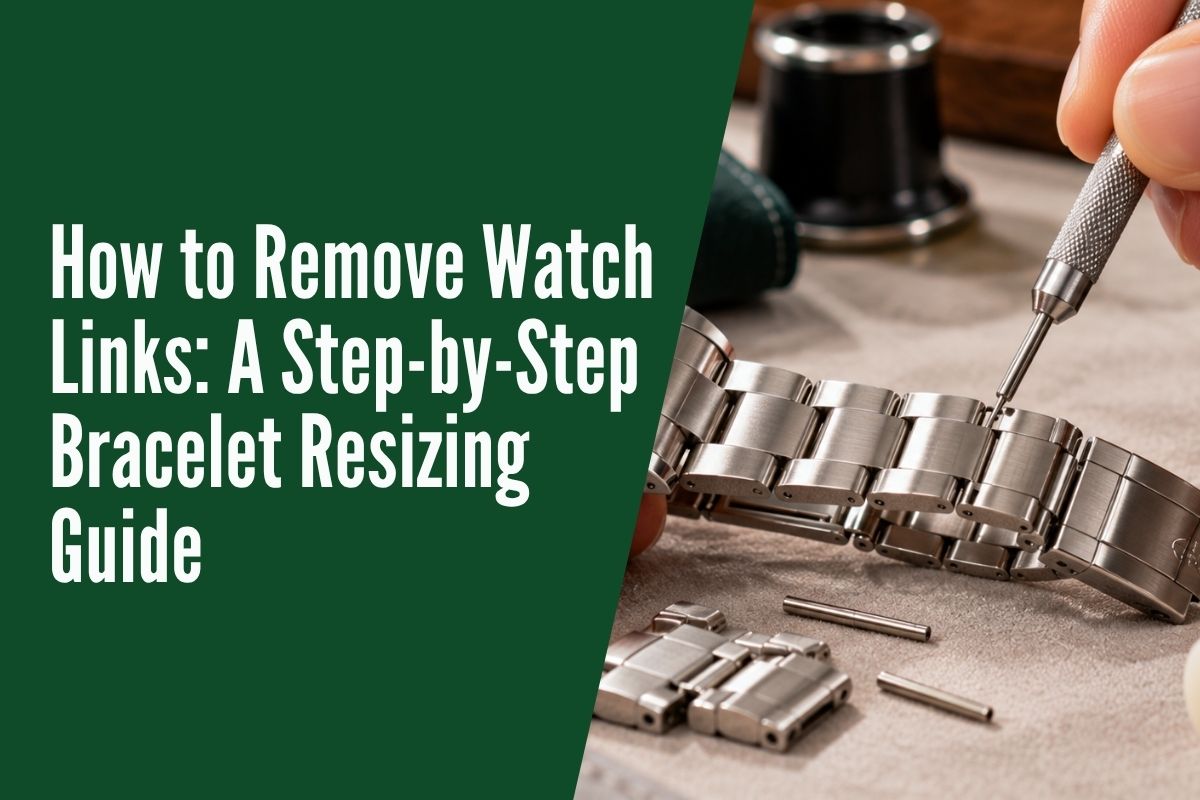
A watch bracelet that feels slightly too loose can quickly become annoying. The temptation is to push out the nearest pin and remove a link, but that can be the wrong move if the bracelet uses screws, retaining collars, or a different adjustment system.
If you are learning how to remove watch links, the most important thing is to identify the bracelet construction before touching any pins or screws. A method that works perfectly on one metal watch band can damage another.
The first step is therefore not removing anything. It is understanding what is holding the bracelet together.
How to Remove Watch Links Step by Step
The method below applies to a standard metal watch bracelet with directional push pins. If your bracelet uses screws, retaining collars, or another link system, use the relevant method later in this guide.
Step 1: Check Whether You Actually Need to Remove a Link
Put the watch on and check how much extra movement you have. If it is only slightly loose, you may not need to remove a full link.
Look at the clasp first. Some bracelets offer micro-adjustment holes, a built-in extension, tool-free adjustment, or a half link that can fine-tune the fit with a smaller change. Seiko and Citizen both use clasp-based adjustment systems on certain models.
As a general guide, the bracelet should feel secure without pressing into your wrist. Citizen recommends enough room to fit one finger comfortably beneath the band.
Do not size the bracelet too tightly. Your wrist can expand slightly in warm conditions or during activity, so leave enough room for comfortable movement throughout the day.
Step 2: Identify the Removable Links
Turn the watch bracelet over and inspect the underside of the links. On many push pin bracelets, the removable sections are marked with engraved arrows. These markings show which links are designed to come apart and the direction in which the pin should be pushed.
Do not treat every link as removable. End links, clasp connections, and unmarked sections may form part of the bracelet structure and should normally be left alone unless the manufacturer specifically allows their removal.
If you cannot see any arrows, stop before applying pressure. The bracelet may use screws, collars, tubes, or another fastening system, so first identify the construction rather than assuming the pin can be pushed out from either side.
Quick Identification Check
Look closely at the side and underside of the bracelet:
| What You See | Likely Link System |
|---|---|
| Engraved arrows underneath the links | Directional push pins |
| Small screw heads on the side of the links | Screw links |
| Plain pin holes with no arrows | May use pins with collars or tubes |
| No obvious pin or screw access | Proprietary or concealed adjustment system |
If the fastening method is unclear, do not force the link apart. Confirm the bracelet design first, especially on a luxury watch where damaged screws, pins, or link edges can be costly to repair.
Step 3: Decide How Many Links to Remove
Wear the watch and pinch the excess bracelet length to judge how much needs to come out. Start conservatively so you can make another adjustment later if needed.
For two links, removing one from each side usually keeps the clasp well positioned beneath the wrist. With an odd number, the distribution may need to be uneven depending on the bracelet design and wrist shape.
Use clasp position as the deciding factor rather than following a fixed rule about removing equal numbers from both sides.
Step 4: Prepare the Watch and Your Workspace
Set up a stable, well-lit surface before touching the bracelet. Use a soft watch mat or folded microfibre cloth, a bracelet sizing block, the correct pin pusher, tweezers, and a small watchmaker's hammer only when the link system requires one. Keep a tray nearby for pins, collars, screws, and other small parts. Protective tape can also help shield polished surfaces from accidental marks.
Support the bracelet so there is an open space beneath the pin you are removing. The pin needs room to exit freely. Pressing it against a solid tabletop can stop it from moving and may lead to excessive force.
Good preparation reduces the risk of scratches, bent pins, and lost retaining collars during watch bracelet resizing.
Step 5: Push the Pin Out in the Correct Direction
Place the bracelet securely in the holder and align the pin pusher squarely with the pin. On links marked with arrows, apply steady pressure in the indicated direction until the pin begins to emerge.
Once enough of the pin is exposed, withdraw it carefully with tweezers or suitable pliers. Avoid twisting or levering it sideways, as that can damage the pin or link opening.
Stop immediately when the pusher starts bending, the pin refuses to move, the bracelet begins to distort, or the fastener shows a screw slot. A round end does not always mean you are dealing with a simple push pin. Some bracelets use screws, collars, tubes, or combined pin systems that require a different removal method.
Step 6: Watch for Collars, Tubes, Sleeves, or Springs
Some metal watch bracelets use more than a single pin to hold each link together. As the pin comes out, a tiny collar, sleeve, tube, or spring may also come loose.
Stop and note exactly where it came from. These small parts are part of the fastening system, not debris. Missing or incorrectly refitting one can leave the bracelet pin insecure.
Work over a watch mat, folded cloth, or tray so nothing can roll onto the floor.
Step 7: Remove the Link and Reconnect the Bracelet
Once the fasteners are fully removed, separate the required link without twisting or levering the bracelet. Resistance usually means something is still engaged.
Bring the remaining sections together, then:
- Return any collar, sleeve, or spring to its original position.
- Insert the bracelet pin from the opposite side to the direction used for removal.
- Press it in carefully until it sits correctly within the link.
The pin should align naturally with the link holes. Do not force it at an angle.
On a pin and collar bracelet, a pin that slides in with almost no resistance can indicate a missing collar.
Step 8: Check the Bracelet Before Wearing the Watch
Treat the final inspection as a safety check. Seiko warns that an incorrectly seated or protruding pin can work loose or cause injury while the watch is being worn.
Check that:
- Every pin is fully seated and centred
- No pin or screw protrudes from the bracelet
- All collars, tubes, sleeves, springs, and other parts are accounted for
- Each link moves normally
- The reconnected joint stays secure under gentle pressure
- Clasp opens and closes correctly
- Watch feels comfortable
- The clasp sits in a suitable position beneath the wrist
A slightly loose fit may only need a final clasp adjustment rather than another full link removal.
Keep every spare link and fastening component with the watch box and paperwork. They may be needed for future bracelet resizing or when selling the watch.
Identify Your Watch Link Type Before Removing Anything
The fastening system determines how the bracelet should be resized. Arrows alone can indicate a removable link, but the component holding that link together may still vary.
Seiko and Citizen both publish bracelet-specific adjustment instructions because different constructions require different handling.
| What You See | Likely Bracelet System | Correct Approach | Main DIY Risk |
|---|---|---|---|
| Arrow underneath with round pin ends | Push or friction pin | Push the pin in the arrow direction | Bent pin or scratched link |
| Arrow with a tiny internal sleeve | Pin and collar | Remove the pin and retain the collar | Lost collar |
| Split-looking pin end | Split pin | Follow the specified removal direction | Bent pin |
| Screw slot on one side | Screw link | Use the correct precision screwdriver | Stripped screw head |
| Screw slots on both sides | Double screw or screw and tube | Use correctly sized drivers as required | Slipping or stripping |
| Release button built into the link | Tool-free link | Operate the release mechanism | Forcing an unnecessary pin |
| Sliding clasp on fine mesh | Milanese or mesh bracelet | Move the clasp to resize the band | Damaged clasp |
| Stretching bracelet | Expansion bracelet | Follow the model-specific adjustment method | Bent tabs or clips |
| No arrows or identifiable fastener | Proprietary or unknown system | Check the watch or bracelet instructions | Bracelet damage |
If you cannot confidently identify the system, do not test different tools until something moves. Check the watch or bracelet instructions first.
How to Remove Links From a Watch With Screws
A screw link has a defined screwdriver slot on the side of the bracelet. Use a watchmaker's screwdriver that fills the slot closely, support the bracelet firmly, and keep the driver straight while applying controlled downward pressure.
The blade fit matters. A screwdriver that is too small can slip and damage both the screw head and the surrounding link. Some bracelets also use double screw or screw and tube systems, which may require a second driver to hold the opposite side.
Stop if the screw is seized, the slot starts deforming, or the driver repeatedly slips. Do not switch to a hammer or pin punch, and avoid heat, penetrating oil, or thread-locking compounds unless the manufacturer specifically recommends them.
Once loosened, remove the required link, reconnect the bracelet, and reinstall the screw according to the model-specific procedure.
Extra caution is sensible with Rolex, Omega, Audemars Piguet, Patek Philippe, Cartier, and other high-value watches. Time Is Money Watches can handle bracelet sizing professionally when the mechanism is unfamiliar or resistant.
Can You Remove Watch Links Without a Tool?
Sometimes, but only when the bracelet was designed for it. A watch with a built-in release system is very different from a standard metal bracelet that normally needs a pin pusher or screwdriver.
Tool-Free Bracelet by Design
Some bracelets use release buttons or proprietary adjustment systems that let you separate links without conventional sizing tools. The Apple Watch Link Bracelet is a clear example, as its links have integrated quick release buttons.
Use the mechanism provided for that bracelet. Do not apply push pin instructions simply because the links look similar to those on a traditional metal watch band.
Improvised Household Tools
A paper clip, thumbtack, or similar object may move a loose pin, but success depends entirely on the bracelet construction.
The main risks are simple:
- Tool slips across the link
- Pin is pushed off centre
- Makeshift tool bends
- The pin opening becomes damaged
Some manufacturers do permit specific household objects for particular bracelet systems, so improvised tools are not automatically wrong. The safer rule is to use them only when the manufacturer's instructions explicitly allow it. Otherwise, use a correctly sized watch link removal tool.
What If Your Watch Bracelet Has No Arrows?
No arrows does not mean the pin can be pushed out from either side. The bracelet may use screws, a pin and tube system, a pin and collar arrangement, quick release links, mesh adjustment, expansion links, or another proprietary fastening method.
Inspect both sides of the link under bright light or magnification. Look for a screwdriver slot, split pin end, small sleeve, release button, or sliding clasp component before choosing a tool.
Older and vintage watch bracelets may not use the markings found on many modern designs, so identification matters even more.
When the construction is unclear, check the manufacturer's bracelet instructions or model manual. Do not increase force simply because you cannot see an arrow.
Watch Link Removal Problems and How to Fix Them
Most watch link removal problems come down to direction, alignment, or identifying the wrong fastening system. Before increasing force, check the cause first.
- The watch pin will not come out: Confirm the removal direction, make sure the fastener is not a screw, check that the pin has space underneath to exit, and realign the pin pusher. A collar, tube, or proprietary system may also be holding the link together. No movement after these checks means it is time to stop.
- The pin comes halfway out and stops: Your link removal tool may simply have reached the end of its travel. Before switching to a hammer or applying more pressure, inspect the exposed pin and link for a tube, sleeve, or other retaining component.
- A tiny metal tube fell out: Keep it. The part is likely a collar or sleeve used to secure the bracelet pin. Identify where it came from and reinstall it correctly before wearing the watch.
- The pin slides back in too easily: Check for a missing collar or tube. A pin can appear correctly seated while still lacking the component that keeps it secure.
- The clasp is no longer centred: Bracelet length may be correct even though the link distribution is not. Moving links between the 6 o'clock and 12 o'clock sides can improve clasp position without changing the overall circumference.
- One more link makes the watch too tight: Use the clasp micro-adjustment where available. A half link, built-in extension, or tool-free adjustment system may provide the smaller change you need without sacrificing comfort.
When Should You Have a Watch Professional Remove the Links?
DIY bracelet resizing is reasonable when the fastening system is clear and the components move as expected. Once resistance, damage, unusual materials, or uncertainty enter the process, professional sizing becomes the safer option.
Consider taking the watch to a professional when:
- You cannot identify the fastening mechanism
- A correctly aligned pin will not move
- A screw is seized, or its slot is already damaged
- The bracelet contains gold, ceramic, or another premium material that marks easily
- The watch is vintage, and replacement parts may be difficult to source
- Pin, screw, collar, sleeve, or tube has been lost or damaged
- Bracelet uses an unfamiliar proprietary system
- You are uncomfortable applying force to a high-value watch
The cost of professional bracelet adjustment is usually minor compared with refinishing a scratched luxury bracelet, replacing damaged hardware, or repairing a fastening system that was reassembled incorrectly.
A Better Fit Should Never Cost You the Bracelet
Removing watch links safely starts with knowing exactly how the bracelet is secured. Once that is clear, the rest comes down to careful handling, the correct tools, and checking the bracelet properly before wearing the watch again.
Resistance is a reason to reassess the mechanism, not apply more force. A simple push pin bracelet may be manageable at home, while vintage pieces, ceramic bracelets, precious metals, and unfamiliar luxury watch systems leave far less room for error.
For Rolex, Audemars Piguet, Patek Philippe, Omega, Cartier, TAG Heuer, Richard Mille, and other luxury watches, we can help with bracelet-related work, repairs, and servicing at Time Is Money Watches. You can also visit our Hale showroom for in-person assistance.
FAQs
Can you remove watch links yourself?
Yes, many conventional metal bracelets can be resized at home when you can clearly identify the fastening system and have the correct tools. Directional push pin bracelets are generally among the simpler designs. Stop once the mechanism becomes unclear or requires excessive force. Screw systems, proprietary bracelets, valuable watches, and delicate materials deserve greater caution because a sizing mistake can damage more than the removable link itself.
Which way do watch pins come out?
On a directional push pin bracelet, follow the arrow engraved underneath the removable link. The arrow normally indicates the direction the pin should travel during removal. Do not assume the same rule applies to an unmarked bracelet. Different watches may use split pins, collars, tubes, screws, or other fastening systems, so identify the construction before applying pressure.
How many links should I remove from my watch?
Remove only enough length to achieve a secure, comfortable fit. One link may be sufficient for a slightly oversized bracelet, while a larger adjustment may require more. Rather than deciding by link count alone, check how the watch sits and where the clasp rests beneath your wrist. Small clasp adjustments or half links can sometimes achieve a better result than removing another full link.
Can removed watch links be put back in?
Usually, yes. A removable bracelet link can generally be reinstalled as long as you retain its original pin, screw, collar, sleeve, or other fastening parts and none have been damaged. Keeping the complete hardware together makes future resizing much easier.
How tight should a watch bracelet be?
A bracelet should hold the watch securely without pressing uncomfortably into your wrist or restricting normal movement. Leave enough tolerance for natural changes in wrist size during the day. The ideal fit also depends on the watch's weight and bracelet design, so comfort matters more than achieving a particular measurement. Fine adjustment systems can help when a full link creates too large a change.
Should you remove watch links from both sides?
Not necessarily. Removing links evenly can help maintain clasp position, particularly when taking out an even number, but it is not a universal rule. Wrist shape and bracelet construction can require an uneven distribution. Judge the finished result by how naturally the clasp sits beneath the wrist rather than assuming both sides must always contain the same number of removable links.
Can a jeweller or watchmaker remove watch links?
Yes. A competent jeweller or watchmaker can resize many metal watch bracelets and is particularly useful when the fastening system is unfamiliar or the watch is valuable. Brand specialists may also have model-specific tools and procedures. Rolex confirms that its Official Retailers can add or remove bracelet links using the appropriate expertise and equipment.