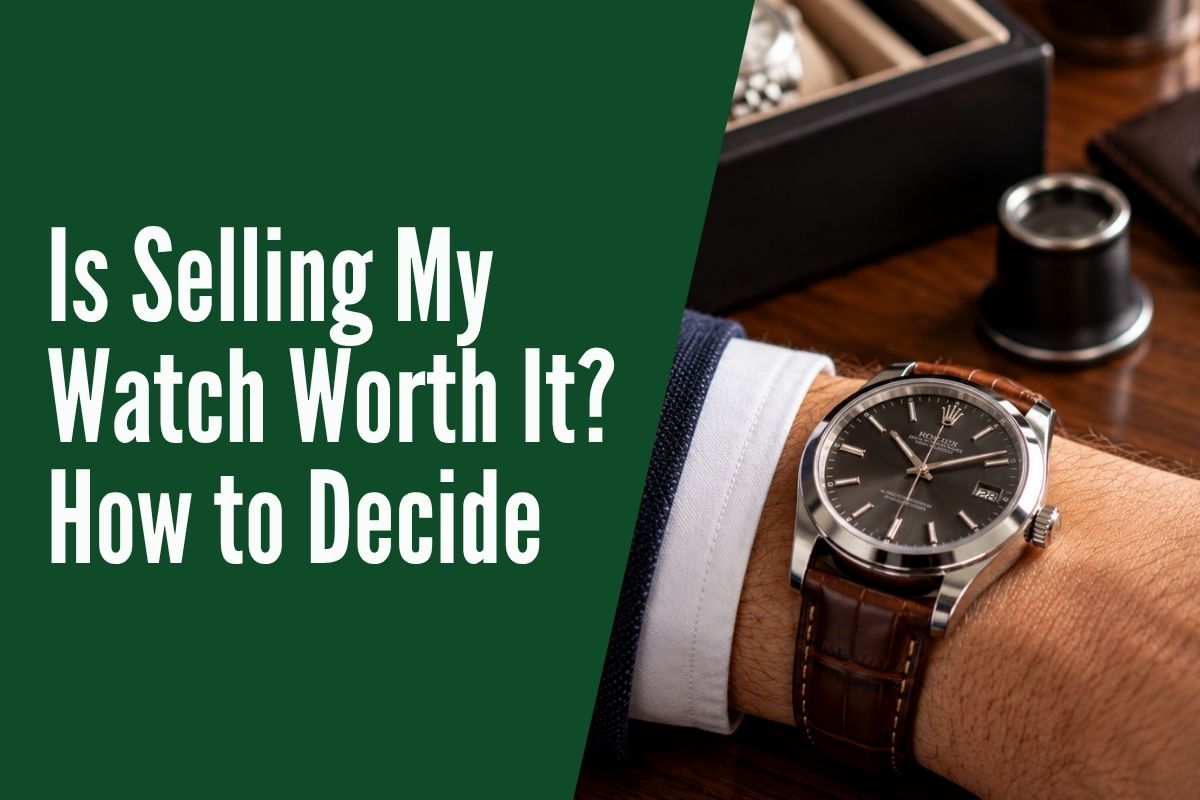
A watch may be worth £8,000 on paper, but that does not automatically mean selling it is a good move. You might receive less than the prices you see online, or discover later that replacing the same reference costs far more than expected.
Selling makes sense when the amount you can actually walk away with has more value to you than keeping the watch. To work that out, you need to consider buyer demand, realistic offers, selling costs, how easily the watch could be replaced, and whether you would genuinely miss owning it.
This guide will help you judge those points before you sell, so you can make the decision with a clearer idea of what your watch is worth to the market and to you.
Is Selling My Watch Worth It?
Selling your watch can be worth it if the amount you are likely to receive feels more useful than keeping the watch. There is no universal yes or no answer because value is not purely financial.
Three things usually matter most:
- Financial value: Is the realistic offer close to what you would be comfortable accepting?
- Practical value: Would the cash help with another purchase, an upgrade, or something more important to you?
- Personal value: Would you regret losing this exact watch, especially if it has sentimental meaning or may be difficult to replace?
It also helps to separate liquidity from appreciation. A watch can be easy to sell without having increased in value. Some models trade frequently yet still sell below their original retail price.
Even within brands such as Rolex, resale performance can differ considerably between references, dial combinations, materials, condition, and current buyer demand.
What Should You Consider Before Selling Your Watch?
Before you sell, look at more than the headline value of the watch. How much you use it, what buyers will genuinely pay, and how difficult it would be to replace can all change whether a sale feels worthwhile.
1. How Much Do You Actually Wear It?
Think back over the past six to twelve months. Has the watch had regular wrist time, or has it spent most of that period in its box?
If you rarely wear it, turning that value into cash or using it towards another watch may suit you better. An expensive piece that no longer fits your collection can tie up a sizeable amount of money without giving you much enjoyment.
Usage alone should not make the decision for you, though. A watch inherited from a parent or linked to an important event may have far more personal value than its resale figure suggests.
2. How Much Will You Actually Receive?
Online listings can create unrealistic expectations because an asking price only tells you what a seller hopes to receive. It does not show whether the watch sold for that amount.
Before deciding, get 2 or 3 genuine purchase offers and compare them carefully.
- Retail or dealer asking price: The price advertised to the next buyer.
- Private sale price: What you may achieve by finding and dealing with the buyer yourself.
- Dealer purchase offer: The amount a specialist is prepared to pay you directly.
- Net proceeds: What remains once every selling cost has been deducted.
A useful calculation is:
Sale price - fees - servicing or preparation- shipping or insurance - other costs = net proceeds
Use that final figure when judging whether the sale is worthwhile.
Time Is Money Watches offers free valuations for luxury watches, so you can request an indicative figure before deciding whether you want to proceed with a sale.
3. Could You Replace the Watch Later?
Consider what buying the same watch again would involve. A current production model may be fairly straightforward to source, while a discontinued reference, uncommon dial, vintage example, or particularly clean piece could be much harder to find again.
Original box and papers, provenance, condition, service history, and a complete set can also make one example more desirable than another.
Money can replace many watches. It cannot recreate family history or the memories attached to a particular one.
4. What Will You Do With the Money?
Selling usually has more purpose when you already know what the proceeds will do for you. You may want to fund another watch, release money from an underused collection, reduce the number of pieces you own, or pay for something more important outside watches.
If another timepiece is already on your radar, part exchange is also worth considering. Instead of selling first and buying separately, you can put the value of your existing watch towards the next one. Time Is Money Watches currently offers part exchange alongside its valuation service.
What Determines How Much Your Watch Is Worth?
Your watch should be valued on its exact specifications and current market, not just the brand name.
- Exact reference and configuration: Reference number, dial, bezel, case material, bracelet, size, production year, and production variation can all affect value. 2 Rolex Submariners can have very different resale prices if the references or configurations differ.
- Condition and originality: Buyers will inspect the case, crystal, bezel, bracelet, clasp, dial, hands, movement, and any visible damage. For vintage and collectible watches, original components can be especially important. Heavy polishing or replacement parts may reduce collector appeal.
- Box, papers, spare links and service history: A genuine watch can still be sold without its box or papers, but missing items may affect value or buyer confidence. Spare links matter because they determine how easily the bracelet can be resized. There is no standard deduction for missing accessories. A recent service can help reassure a buyer, but the cost of that service is not automatically added to the selling price.
- Current demand: Demand varies by reference and configuration. A steel sports model may perform very differently from a dress watch, 2-tone version, or precious metal model from the same brand.
Should You Sell Your Watch Now or Keep It?
Timing matters, but your own circumstances usually matter more. A strong market can support a sale, yet keeping the watch may still make more sense if replacing it later would be difficult or if the piece carries personal significance.
The comparison below helps separate reasons to sell from reasons to pause.
| Selling may make more sense if | Keeping it may deserve more thought if |
|---|---|
| You rarely wear the watch and do not expect that to change. | The watch has strong sentimental or family value. |
| You already plan to replace it or move into another model. | Finding the same reference again would be difficult or considerably more expensive. |
| You want to release money tied up in a watch you no longer use. | You are reacting mainly to short-term price movements. |
| Several watches in your collection serve a very similar purpose. | You are comparing a genuine dealer offer with optimistic marketplace asking prices. |
| Buyer demand for your exact reference and configuration is currently strong. | You have received only one valuation and have nothing useful to compare it with. |
| Upcoming servicing or repair costs feel hard to justify for a watch you no longer enjoy wearing. | You still enjoy owning and wearing the watch, even if its resale value is attractive. |
One point is worth separating from the rest: what you originally paid is already spent. Keeping a watch purely because you paid more for it than you could sell it for today is a form of sunk cost thinking.
A better decision comes from asking what the watch is worth to you now, both financially and personally.
Is It Better to Sell Privately, to a Dealer, or Part Exchange?
The best route depends on whether you care most about price, speed, convenience, or reducing the work involved in the sale.
| Route | Potential Return | Speed | Seller Effort | Best Suited To |
|---|---|---|---|---|
| Specialist dealer | Lower than private asking price | Fast | Low | Sellers who value convenience and certainty |
| Private sale | Potentially higher | Variable | High | Experienced sellers comfortable managing the transaction |
| Part exchange | Depends on the overall deal | Fast | Low | Owners already planning to upgrade |
| Consignment | Potentially higher than an outright purchase | Slower | Medium | Higher value watches where speed matters less |
| Auction | Uncertain | Slower | Low after consignment | Rare, vintage, or provenance-rich watches |
Dealer Sale
A dealer offer will usually be below the price you later see the watch advertised for. The difference covers authentication, preparation, warranty obligations, stock risk, operating costs, and the margin required to resell the watch.
What you receive in return is a simpler transaction with less exposure to payment issues, shipping concerns, buyer disputes, or time spent finding a purchaser.
Private Sale
Selling privately can produce a higher gross figure, but you take responsibility for the entire process. That includes creating the listing, answering enquiries, verifying payment, arranging insured shipping, and dealing with any dispute that follows.
Compare the extra net amount you expect to keep with the extra work and risk involved. A higher advertised price is less attractive if fees, preparation costs, delivery, or failed transactions reduce the final return.
Part Exchange
If you already know which watch you want next, compare the total cost of changing watches rather than focusing only on the trade-in allowance.
Look at both scenarios:
- Part exchange your current watch and pay the remaining balance.
- Sell it for cash, then purchase the replacement separately.
The better deal is the one that leaves you paying less overall for the move. Time Is Money Watches offers part exchange alongside direct purchasing, so both routes can be considered before you decide.
Should You Service or Polish Your Watch Before Selling It?
Do not automatically service a watch before selling it. Get an as-is valuation first, then compare any expected increase in the offer with the cost of the work.
If an £800 service improves the offer by only £300, you are £500 worse off. Servicing can still make sense when a mechanical issue is materially reducing the valuation, but the numbers should justify it.
Vintage watches need more caution. During servicing, worn components may be replaced, and originality can matter to collectors.
Polishing also deserves restraint. Removing scratches involves refinishing the case, so repeated or aggressive polishing can alter its original shape and edges.
Time Is Money Watches also provides servicing and repairs, which gives owners the option to assess whether any work is financially worthwhile before authorising it.
How to Decide Whether an Offer Is Worth Accepting
An offer is worth accepting when the amount, convenience, and timing suit you better than the alternatives. Before deciding, work through the numbers in a fixed order so you are comparing like with like.
- Confirm the exact reference, configuration, year, and specification of the watch.
- Gather the box, papers, spare links, service records, and any other original accessories.
- Check realistic comparable prices for the same reference and configuration.
- Request 2 or 3 genuine purchase offers rather than relying on one valuation.
- Estimate what you would actually keep from a private sale after fees, shipping, insurance, and preparation costs.
- Compare any extra private sale return with the additional time, effort, and transaction risk involved.
- Consider what it would cost to replace the same watch later and whether the piece carries sentimental value.
- Decide whether cash, part exchange, or simply keeping the watch gives you the best outcome.
Different dealers can value the same watch differently because their current stock levels, customer enquiries, and appetite for a particular reference are not identical. Comparing several quotations gives you a better sense of the price available to you at that moment.
Know Your Watch's Value Before You Decide
Selling only makes sense when the return you can realistically achieve is more useful to you than keeping the watch. Online listings can help with research, but they should not be treated as guaranteed selling prices.
A professional valuation gives you a firmer starting point. It can show what your watch may be worth in its current condition and whether selling, part exchange, or holding onto it is the better fit for your plans.
Time Is Money Watches buys luxury watches and also offers part exchange, sourcing, servicing, and repairs. If you are unsure what to do next, start by finding out what your watch is genuinely worth and what options are available.
A clear valuation makes the decision easier, even if you ultimately choose not to sell.
FAQs
How do I know if my watch is worth selling?
Start with a current valuation rather than the price you originally paid. Check the exact reference, condition, accessories, service history, and current demand, then obtain two or three genuine purchase offers. Compare those figures with what the watch is worth to you personally. If the realistic net amount would be more useful than keeping the watch, selling may make sense.
Should I sell my Rolex now or wait?
There is no single answer for every Rolex. Resale performance depends on the exact reference, configuration, condition, and current demand rather than the brand name alone. Compare recent market data with genuine purchase offers and consider whether you would want to replace the watch later. Waiting only makes sense if you are comfortable continuing to own the watch without assuming that its value will rise.
Why is a dealer offer lower than online watch prices?
Dealer asking prices include more than the amount paid to the previous owner. A dealer must account for authentication, preparation, operating costs, warranty obligations, stock risk, and resale margin. An online listing may also show an asking price rather than the amount a watch actually sells for.
Is it better to sell my watch privately or to a dealer?
A private sale may produce a higher gross price, but you handle enquiries, payment, shipping, insurance, and transaction risk yourself. A dealer will usually offer less than a private asking price but can provide a faster and simpler sale. Compare the extra amount you may keep privately with the additional time, costs, and exposure involved before choosing between the two.
Is part exchange better than selling a watch?
Part exchange can be useful if you already know which watch you want next. Instead of judging only the trade-in allowance, compare the total cost of changing watches. Look at the price of the incoming watch and the value offered for your current one, then compare that result with selling for cash and buying separately. The route that leaves you paying less overall may be the stronger option.
Can I sell a watch without the box and papers?
Yes. A genuine watch can still be sold without its original box or papers. However, missing accessories may affect value because some buyers prefer a complete set and may feel more confident when original documentation is present. There is no universal percentage deduction. The effect depends on the brand, reference, age, condition, and market demand for that specific watch.
Should I service my watch before selling it?
Not automatically. Get an as-is valuation first and compare the likely increase in the offer with the service cost. If an £800 service improves the offer by only £300, servicing reduces your net return. Vintage watches need additional care because replacing original components can affect collector interest. Rolex confirms that components which no longer meet its standards may be replaced during a full service.
Will scratches reduce my watch's value?
They can, but the effect depends on severity and on the type of watch. Light wear is expected on many pre-owned pieces, while deep scratches, dents, damaged bezels, or heavily worn bracelets may have a greater impact. Condition is one of the factors used when estimating market value. Avoid assuming that polishing will always improve the price, especially with collectible watches where case originality can matter.
Will I regret selling my watch?
Possibly, especially if the watch has sentimental value or would be difficult to replace. Before selling, consider whether you would want the same reference again later and what buying it back might cost. Family watches and pieces linked to important events deserve extra thought because their personal value cannot be recreated by purchasing another example. If you are unsure, obtaining a valuation does not commit you to selling.