A fake Rolex no longer gives itself away easily. That is what makes it dangerous.
Today’s replicas are built with a level of detail that can mislead even trained eyes. The finish looks convincing, the proportions feel right, and at first look, everything appears in place. Buying without proper knowledge has become far riskier than before. In fact, over a million counterfeit watches are believed to be circulating in the U.K, which shows how widespread the issue has become.
Money is lost not through carelessness, but through misplaced confidence.
This guide walks you through a clear, reliable way to evaluate a Rolex so you can make informed decisions without second-guessing.
Read closely, what you notice next can save your hard-earned money.
Why Is Spotting a Fake Rolex Harder Today?
The problem is not that fakes exist. It is that they are built to pass.
Manufacturers are no longer cutting corners in obvious places. They study genuine Rolex watches in detail and replicate what buyers tend to check first. You will find replicas that mirror the layout of calibres similar to the 3235, use a sapphire crystal, and apply lume that glows evenly in low light. None of these elements confirms authenticity anymore, but they do create enough confidence to lower your guard.
This is exactly where older advice starts to fail. What used to expose a fake now blends in:
- A smooth second hand is no longer a strong signal.
- The weight of the watch often feels right in the hand.
- Serial numbers and warranty cards can look clean and consistent.
Imagine a private seller offering a Submariner with full box and papers. The watch feels solid, the dial looks sharp, and nothing seems out of place during a quick look. For a beginner, there is no clear reason to question it. That is how convincing these pieces have become.
That changes how you need to approach authentication. You are not looking for a single giveaway. You are building a case. Each detail either supports authenticity or adds doubt. When you examine a watch in this way, you stop relying on isolated checks and start reading the watch as a whole.
A Beginner’s Step-by-Step Rolex Authentication Flow
Step 1: Quick checks you can do in minutes
1. Second Hand Movement
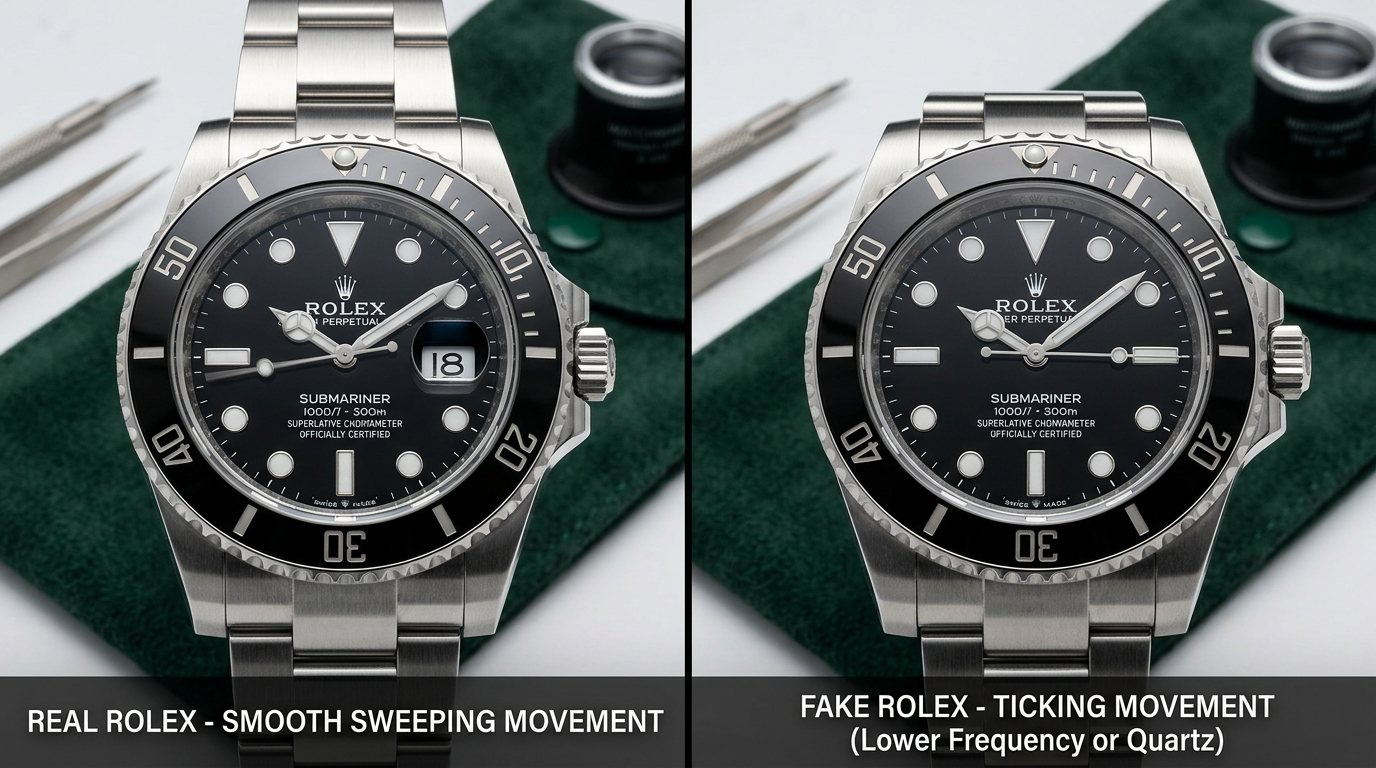
Watch how long someone looks at the second hand. That alone tells you how they are judging the watch.
A quick glance is not enough anymore. Modern replicas are built to pass that exact moment. They appear smooth for just long enough to gain your trust.
So change how you look.
Start with the obvious check. If the second hand ticks once per second, you can rule the watch out immediately. That part has not changed. A genuine Rolex runs at around 28,800 beats per hour (8 ticks per second), which creates the smooth sweeping effect.
Now go one level deeper. Do not look away after two seconds. Keep your eyes on the hand as it moves across multiple markers.
Here is what to pay attention to:
- Consistency of motion: On a genuine Rolex, the sweep stays steady from start to finish. It does not draw attention to itself. The pace feels controlled and even.
- Micro stepping under focus: On a strong replica, the hand can appear smooth at first, but extended viewing reveals tiny segmented movements. It is subtle, but once seen, it is hard to ignore.
- Behaviour across the dial: Watch how the hand travels over indices. A genuine piece maintains the same rhythm throughout. Replicas can show slight irregularity when passing certain points.
A simple trick that works in real buying situations: record a short, slow-motion video on your phone. What looks fluid in real time often exposes fine stepping when slowed down.
2. Weight and Material Feel
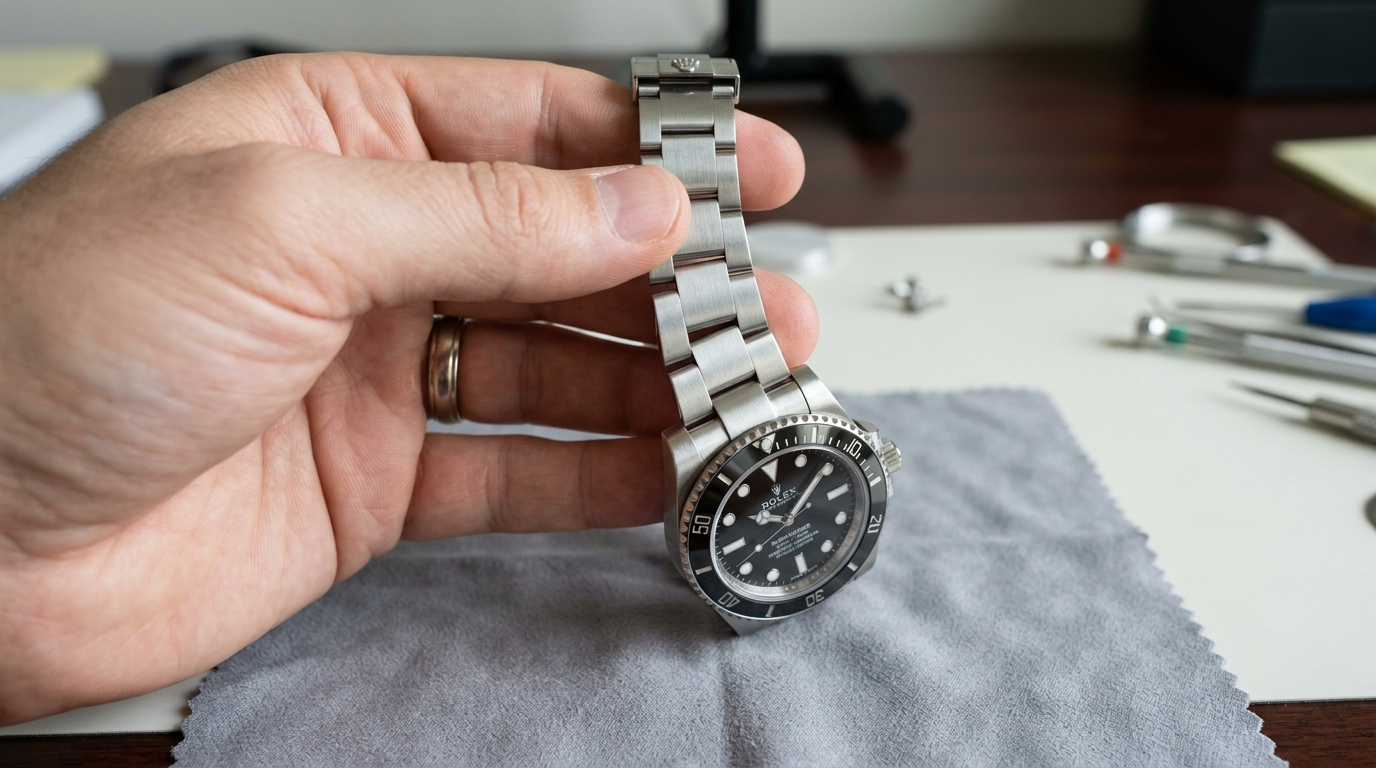
Pick up the watch. Do not judge the weight alone. Judge how it sits.
A genuine Rolex uses 904L stainless steel (often referred to as Oystersteel), which gives it a dense but controlled feel. The weight is evenly distributed across the case and bracelet. Nothing feels hollow, nothing feels exaggerated.
Replicas have caught up on total weight. That is where many buyers get misled.
Focus on this instead:
- Balance: A real Rolex feels stable in the hand. It does not tilt awkwardly or feel top-heavy.
- Bracelet movement: The links flow smoothly when you move them. No stiffness, no loose rattling.
- Clasp feedback: Closing the clasp feels precise and firm, not soft or overly loose.
- Weight distribution: Replicas often get the number right but miss the feel. The case can feel heavier than the bracelet, or the watch may not sit naturally on the wrist.
Quick test: hold the watch lightly and tilt it. A genuine piece stays composed. A replica can feel slightly off balance.
Weight can help you reject a bad fake. It cannot confirm a good one.
3. Cyclops Lens Magnification
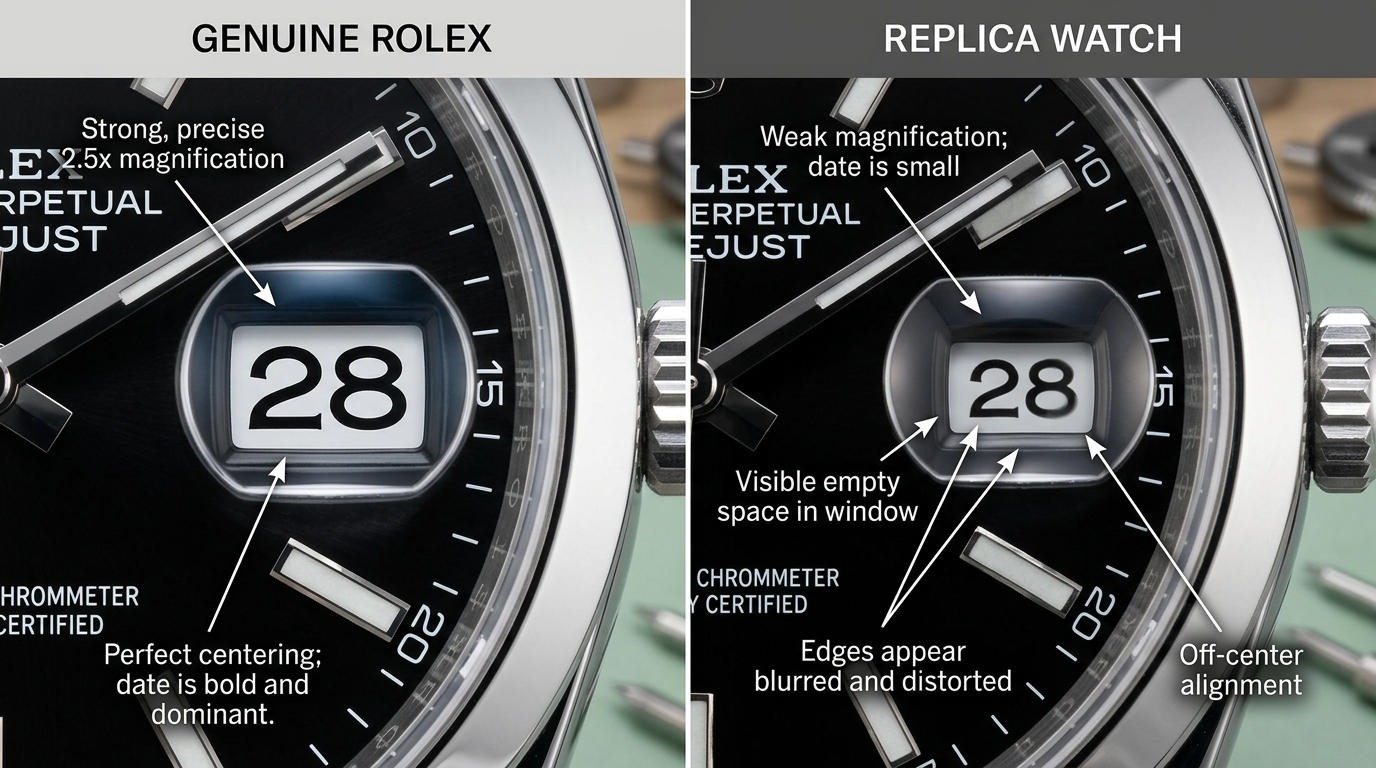
The date window is one of the easiest places to catch a watch that is not right if you know what to expect.
On a genuine Rolex, the cyclops lens enlarges the date to around 2.5 times. The number appears bold, fills most of the window, and sits cleanly in the center. You should not need to adjust your angle to read it. It looks clear straight on.
Where replicas slip:
- Weak magnification: The date looks smaller than it should, leaving too much empty space around it.
- Off-center alignment: The number sits slightly high, low, or shifted to one side within the window.
- Distortion: Edges of the number can appear warped or slightly blurred, especially when viewed from different angles.
This check still works well against mid-tier fakes. They often struggle to match both the strength and precision of the magnification.
Quick way to judge: compare how dominant the date looks. On a real Rolex, it stands out immediately. On a replica, it often looks like it is sitting behind the glass, not through it.
4. Sound Test
Bring the watch close to your ear and listen carefully.
A genuine Rolex runs quietly. You should not hear a pronounced ticking sound in normal conditions. The movement operates with a level of refinement that keeps noise to a minimum.
Lower quality replicas struggle here. They often produce a noticeable tick, especially in a quiet room. If you can clearly hear the watch without trying, that is a strong warning sign.
Where this check becomes less reliable is with higher-grade replicas. Some are built to run quietly enough that you will not pick up any obvious sound during a quick listen.
So treat this as a filter, not a conclusion.
- Audible ticking is a clear rejection
- Silence does not confirm authenticity
If a watch passes this and the earlier checks, all it tells you is that nothing obvious stands out. It does not prove the watch is genuine. It only means you need to keep going with a closer evaluation.
Step 2: Detail Inspection (Where Real Differences Show Up)
1. Dial Printing and Font Precision
This is where casual inspection ends and careful observation begins.
A genuine Rolex dial is produced with extremely tight tolerances. Every letter, mark, and line is placed with intent. The spacing stays consistent across the dial, the edges of each character look sharp, and even under magnification, you will not see ink spreading or rough outlines.
You are not just reading the text. You are judging how it has been printed.
What to look for:
- Edge sharpness: Letters should appear clean and defined. Any softness or slight blur around the edges is a concern.
- Spacing consistency: The gaps between letters and words remain even. Uneven spacing is often a sign of poor replication.
- Alignment across elements: Text, indices, and logos sit in balance with each other. Nothing looks slightly shifted or out of place.
A simple way to check this is to zoom in using your phone camera. What looks fine to the naked eye can reveal imperfections when enlarged.
Among all visual checks, this is one of the more reliable ones. Replicas can imitate materials and weight, but maintaining this level of printing precision across the entire dial is much harder to get right.
2. Rehaut Engraving Inner Ring
Focus on the inner bezel, the ring between the dial and the crystal. Modern Rolex models feature a repeated “ROLEX” engraving running around this area, along with the serial number positioned at 6 o’clock.
On a genuine piece, this is executed with absolute precision. The text aligns perfectly with the hour markers, and the serial number sits exactly in line with the 6 o’clock index. Nothing feels shifted or slightly off.
What to check:
- Marker alignment: Each engraved “ROLEX” line up cleanly with the dial markers. Even a minor rotation is a red flag.
- Letter definition: The engraving should look sharp and clean. Edges are crisp, not rounded or thick.
- Uniform depth: The cut remains consistent across the entire ring, with no variation in depth or finish.
Replicas often miss the balance here. The engraving may look acceptable at first, but small inconsistencies become apparent under closer inspection. You may notice slight misalignment with markers, letters that appear heavier than they should, or engraving that lacks that precise, clean cut finish.
Use light to your advantage. Tilt the watch and observe how the engraving catches it. On a genuine Rolex, everything stays controlled and consistent. On a replica, the imperfections tend to surface when you take that extra moment to examine it properly.
3. Bracelet and Clasp Quality
Do not stop at the watch head. The bracelet often tells you more.
A genuine Rolex bracelet feels tight, controlled, and refined. The links move smoothly without looseness, the edges feel clean against the skin, and the clasp shuts with a firm, precise click. Nothing feels sharp, noisy, or unfinished.
Replicas can look convincing at first, but the bracelet usually gives them away.
What to notice:
- Link tightness: Fakes tend to have slight play between links, creating a faint rattle when moved
- Edge finishing: You may feel roughness or sharp spots along the sides
- Clasp action: The closure can feel soft, loose, or less defined compared to the solid snap of a genuine piece
- Overall feel: Some bracelets feel hollow or less substantial despite matching the weight
Even when the watch head looks right, the bracelet often breaks the illusion.
4. Case Finishing
Look at how the surface handles light. That tells you more than any spec sheet.
Polished areas should reflect cleanly, almost like a mirror, without distortion. Brushed sections carry a consistent grain, with lines running in one direction and stopping exactly where they should. The boundary between finishes is sharp and deliberate, not blended or uneven.
Where replicas fall short:
- Distorted reflections: Polished surfaces can appear slightly wavy or uneven
- Uneven brushing: The grain may look inconsistent, with lines breaking or changing direction
- Soft transitions: The edge between polished and brushed areas lacks definition
This level of finishing is difficult to reproduce because it demands tight control at every stage, from machining to final polishing. Small variations become visible under light, and once you notice them, the difference is hard to ignore.
Step 3: Verification Methods When Visual Checks Are Not Enough
1. Serial and Model Number Verification
Serial numbers do not protect you. They only tell you whether the story holds together.
Start by checking where the engraving sits. The position depends on the production period. Earlier models place it between the lugs, while newer pieces show it on the inner ring at 6 o’clock. If that detail does not match the watch you are holding, there is already a problem.
Now focus on how the numbers are cut into the metal:
- Precision of engraving: The digits should look clean and deeply set, not faint or roughly marked.
- Edge definition: Each number appears sharp, without spreading or uneven outlines.
Then test the reference against the watch itself. The model number should correspond exactly with what you see. A mismatch between reference and features is one of the fastest ways to rule a watch out.
Here is what catches people off guard. Serial numbers are reused across replicas. You can be looking at a copied number taken from a genuine watch.
So treat this as a consistency check. If something does not line up, you have your answer. If everything aligns, it only means the watch has cleared one more layer of scrutiny.
2. Movement Inspection: Most Reliable Method
Everything discussed so far stays on the surface. This step goes straight to the source.
The movement is what separates a Rolex from a replica. Once the case is opened, there is very little room for imitation to hold up under scrutiny. Genuine Rolex movements such as the 3135 or 3235 calibres are known for consistent finishing and structural precision across all components.
What you should expect to see:
- Clean architecture: The layout looks organised and intentional, with no unnecessary clutter.
- Refined finishing: Surfaces appear smooth and well-treated, not raw or uneven.
- Consistency across components: Bridges, screws, and engravings follow a uniform standard throughout.
Where replicas fall apart is execution. The structure may try to resemble a genuine calibre, but the finishing often gives it away. You may notice rough surfaces, poorly finished edges, or components that look out of place once you examine them closely.
There is also the issue of accuracy. Some replicas use movements that only mimic the appearance of Rolex calibres without matching their internal construction.
This check comes with a condition. The case needs to be opened, and that is not something you should attempt without the right tools or experience. Mishandling the watch can cause damage.
When done correctly, this is one of the most reliable ways to separate a genuine Rolex from a well-made replica.
3. Timegrapher Testing
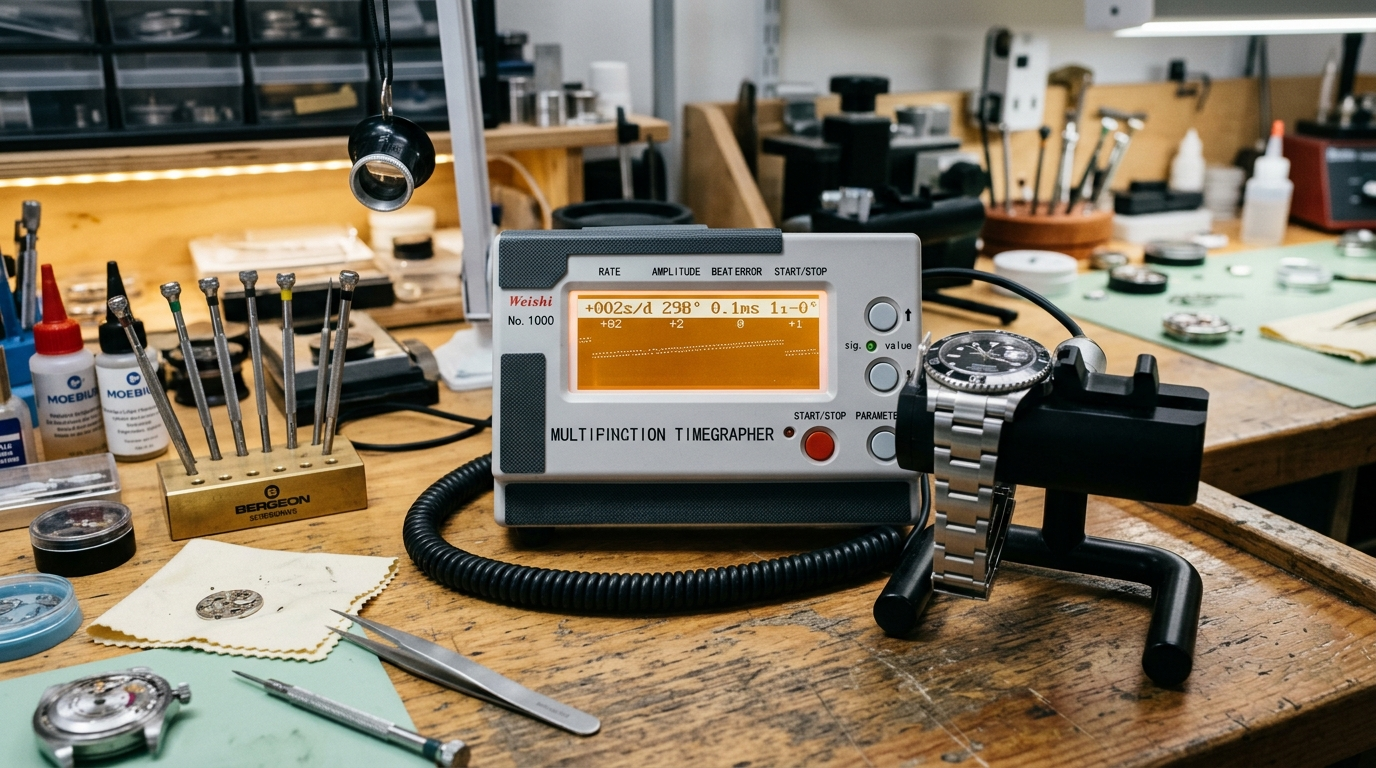
A timegrapher measures how a watch runs, not how it looks. It tracks accuracy, beat rate, and how stable the movement remains across positions.
A Rolex movement is built to operate within tight tolerances. When tested, the readings stay controlled and consistent. The rate does not swing unpredictably, and the movement maintains stability when the watch is placed in different positions.
Replicas can appear acceptable at first, but their behaviour often lacks consistency. You may see fluctuating readings, unstable amplitude, or results that shift noticeably when the position changes. The movement struggles to maintain uniform performance.
This is not a beginner-level check. It requires access to a timegrapher and the ability to interpret the results correctly.
Use this as a validation step. It helps confirm whether the movement performs as expected, but it works best when combined with the earlier checks.
Model-Specific Checks
Rolex Submariner
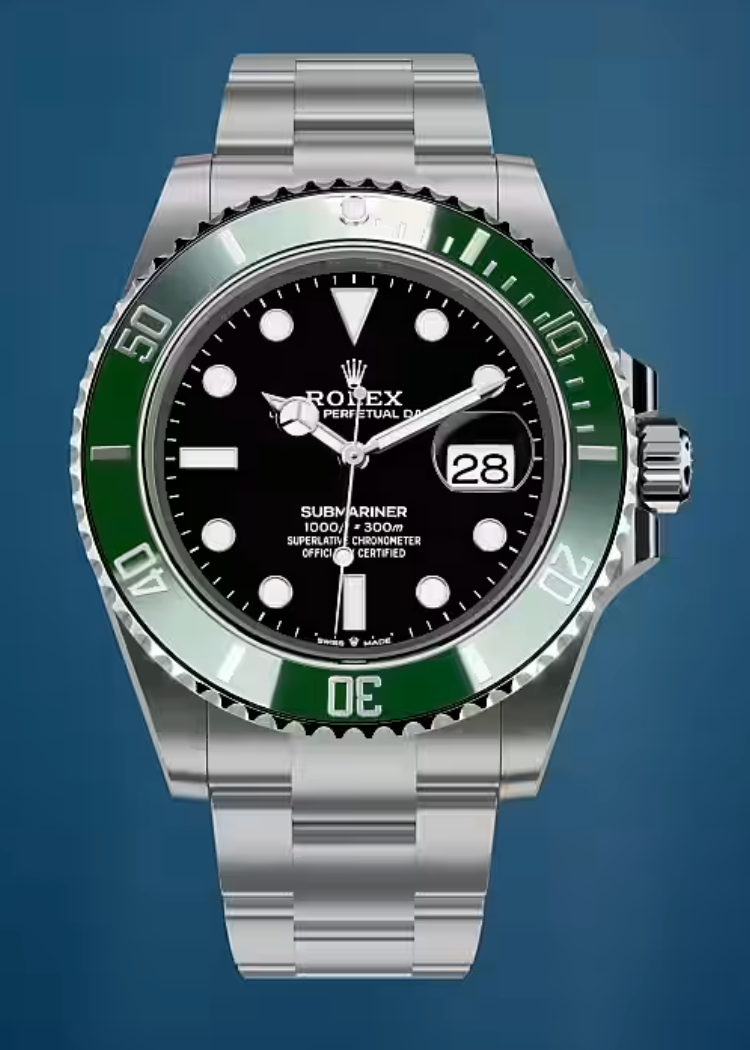
The Submariner gives you two quick ways to judge build quality through interaction.
- Bezel rotation: Turn the bezel slowly. Each click should feel firm and evenly spaced from start to finish. The resistance should stay consistent throughout the rotation. Any looseness, uneven pressure, or variation in feel signals poor execution
- Lume consistency: Check the watch in low light. The glow across markers and hands should appear uniform. No dim spots, no uneven brightness, no early fading in specific areas
On this model, small inconsistencies become easy to notice because these features are meant to perform with precision.
Rolex Datejust
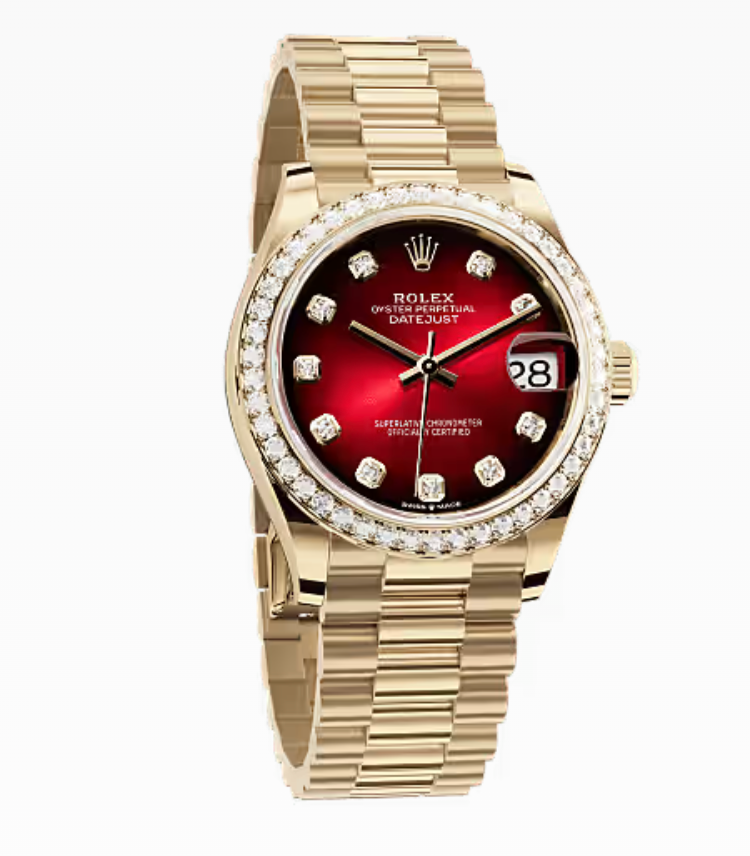
The Datejust draws your attention to the dial, so small errors become easier to spot.
- Cyclops alignment: The date sits at the centre of attention. The magnifier should be perfectly aligned over it, with the number sitting cleanly in the middle. Any shift, even slight, stands out immediately on this model
- Dial finishing: The layout is clean and uncluttered, which makes imperfections easier to notice. Text should appear sharp, markers evenly placed, and the overall spacing balanced. Small inconsistencies that might go unnoticed on busier dials become obvious here
This model leaves little room to hide imperfections, which is where many replicas fall short.
Rolex Daytona
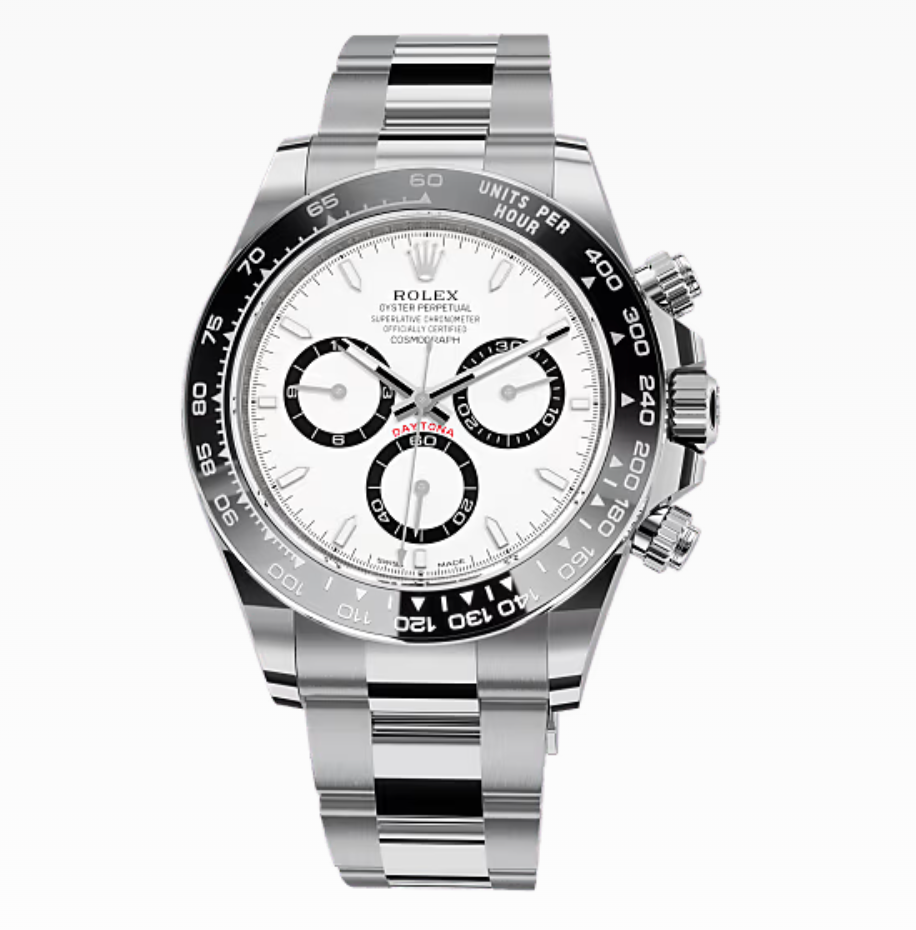
The Daytona is unforgiving. Small errors stand out quickly because the layout is tight and highly structured.
- Chronograph pushers: Press them and feel the response. The action should be clean and controlled, with a clear start and stop. No stiffness, no vague feedback, no delay
- Sub dial spacing: Look at the placement of the sub dials. They should sit in perfect balance with equal spacing and alignment. Even a slight shift becomes noticeable on this model
A common issue with replicas is incorrect subdial positioning. The layout may look close, but the proportions feel off once you focus on it.
This is where engineering shows. Replicas can copy the look, but maintaining correct spacing and functional precision is harder to get right.
Where Are Most Fake Rolex Watches Sold?
Where you buy often matters as much as what you buy. Many problems start long before the watch is in your hand.
High-risk channels tend to follow the same pattern. Sellers focus on speed, persuasion, and price rather than transparency.
- Instagram dealers promoting “1:1 copies.”: Listings look polished, but details about origin and history are often missing
- WhatsApp sellers: Conversations move quickly, with limited proof and pressure to close the deal
- Deep discount private listings: Prices sit well below market value, designed to create urgency and override caution
Common warning signs show up across these channels:
- Unrealistic pricing: A watch listed 30% to 50% below market value should raise immediate concern.
- No verifiable history: Missing service records, unclear ownership, or vague answers about the watch.
- Pressure tactics: Claims of “last piece available” or “offer ends today” to rush your decision.
Safer options follow a different approach. Authorized dealers, established resellers, and platforms that offer authentication checks tend to provide traceability and accountability.
A convincing watch can still be fake. A reliable seller reduces that risk before you even start inspecting the watch.
Make the Final Call with Clarity, Not Assumptions
When your own checks stop giving clear answers, step back and bring in expertise. Certified watchmakers can inspect the movement directly. Established dealers and trusted resellers add another layer by verifying history, condition, and consistency before a watch is offered for sale.
At Time Is Money Watches, authentication is handled by specialists who combine movement inspection with valuation expertise and verified sourcing practices. This gives you access to genuine parts servicing, clear pricing based on actual condition, and secure handling of high-value transactions.
The key is understanding how authentication works today. It is a process of reducing risk, not finding one detail that proves everything. Quick checks help you filter, detailed inspection sharpens your judgement, and professional verification closes the gap when uncertainty remains.
If something does not feel right, that alone is enough to pause. The safer route is always to work with sources that remove doubt before the purchase even begins.
FAQs
What is a Rolex super clone?
A Rolex super clone is a high-quality replica designed to closely mimic genuine models in appearance and movement layout. These watches often replicate details like sweeping seconds, weight, and dial finishing, making them harder to detect. Despite this, internal construction and long-term performance still differ from an authentic Rolex.
Can a fake Rolex have a smooth second hand?
Yes. High-quality replicas now mimic the sweeping motion of a mechanical Rolex, which means a smooth seconds hand is no longer proof of authenticity. What matters is how consistent and controlled the movement appears under closer observation, not just the presence of a sweep.
Do real Rolex watches always feel heavier?
Not always. Genuine Rolex watches feel solid due to high-quality materials, but weight alone is unreliable. Some replicas are intentionally made heavier to match expectations, which makes overall balance and finishing more important than weight itself.
Can serial numbers prove a Rolex is real?
No. Serial numbers help verify consistency, but they are frequently copied from genuine watches. A valid number does not guarantee authenticity unless it matches the watch’s configuration and comes from a trusted source.
Is it possible to tell a fake Rolex without opening it?
In many cases, yes. Dial quality, engraving precision, and overall finishing can reveal issues. However, modern replicas can pass visual checks, which means internal inspection is sometimes required for confirmation.
Where is the safest place to buy a Rolex?
Authorized dealers, established resellers, and platforms with authentication processes offer the lowest risk. These sources verify watches before sale and provide a traceable history, which reduces the chances of buying a counterfeit.
How much does Rolex authentication cost?
Costs vary depending on the level of inspection. Basic checks from watchmakers may be relatively affordable, while full authentication involving movement inspection and valuation can cost more. Pricing depends on the provider and the depth of verification required.
Can box and papers be faked?
Yes. Counterfeiters frequently replicate boxes, warranty cards, and documents to make watches appear legitimate. These should support a watch’s authenticity, not be used as proof on their own.