Rolex Serial Numbers: Complete Guide to Dating Your Watch
You check the serial number on your Rolex, search it online, and suddenly you have three different production years staring back at you. One source says the early 2000s, another points to the late 90s, and now you are left second-guessing the watch itself.
Serial numbers are often treated as a quick answer, yet they rarely tell the full story. Changes in Rolex numbering systems, overlaps between batches, and gaps in public records make things less straightforward than they seem.
Still, these numbers play a major role in how watches are valued, verified, and understood by collectors and dealers alike.
This guide clears the confusion and shows you how to read your Rolex the way professionals do.
What Is a Rolex Serial Number?
A Rolex serial number is a unique code engraved on the watch case, assigned to a single timepiece at the point of production. No two genuine Rolex watches share the same serial number, which makes it a key identifier when you are trying to understand a watch’s background.
For you as an owner or buyer, this number helps estimate the production period, supports initial authenticity checks, and can sometimes link to servicing records if the watch has been maintained through official channels. For example, a serial that aligns with the early 2000s ranges gives you a rough timeframe, which can be cross-checked against the dial, bracelet, and paperwork.
That said, a serial number does not reveal an exact manufacturing date, and it cannot confirm authenticity on its own.
It is also important to separate it from the reference number. The serial number is unique to your watch, while the reference number identifies the model, meaning thousands of watches can share the same reference but never the same serial.
Where to Find the Rolex Serial Number?
Pre-2005 Models (Classic Lug Engraving)
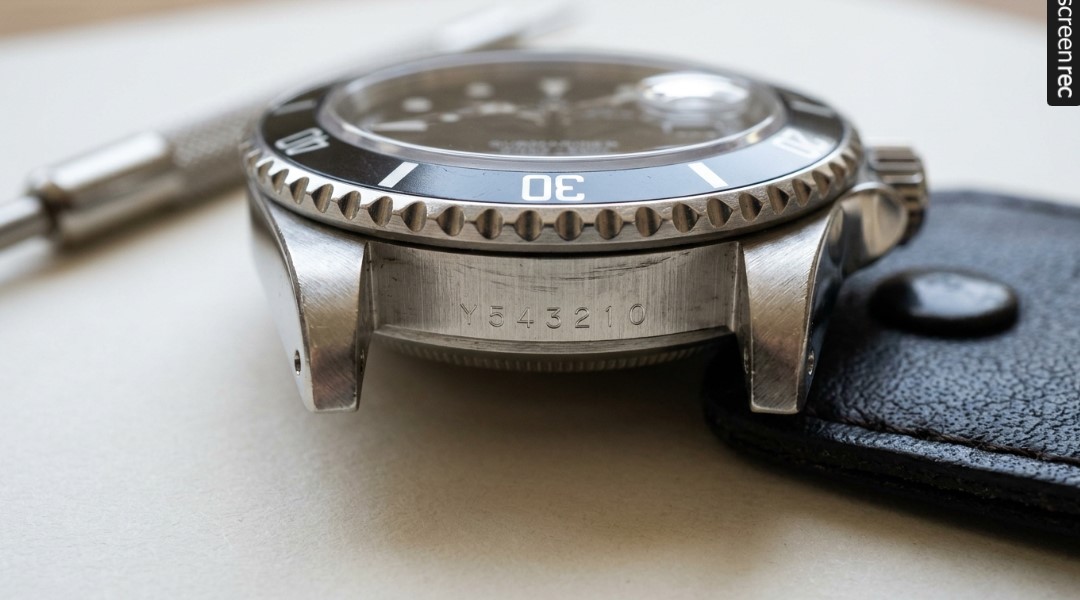
If your Rolex was produced before 2005, the serial number is engraved between the lugs at the 6 o’clock position on the case. You will not see it with the bracelet attached, so the strap or bracelet needs to be removed to access it properly.
Once exposed, the engraving is usually deep, clean, and evenly spaced, reflecting Rolex’s precision finishing standards from that period. The characters should appear sharp and consistent, not faint or irregular.
2005–2008 Transition Models
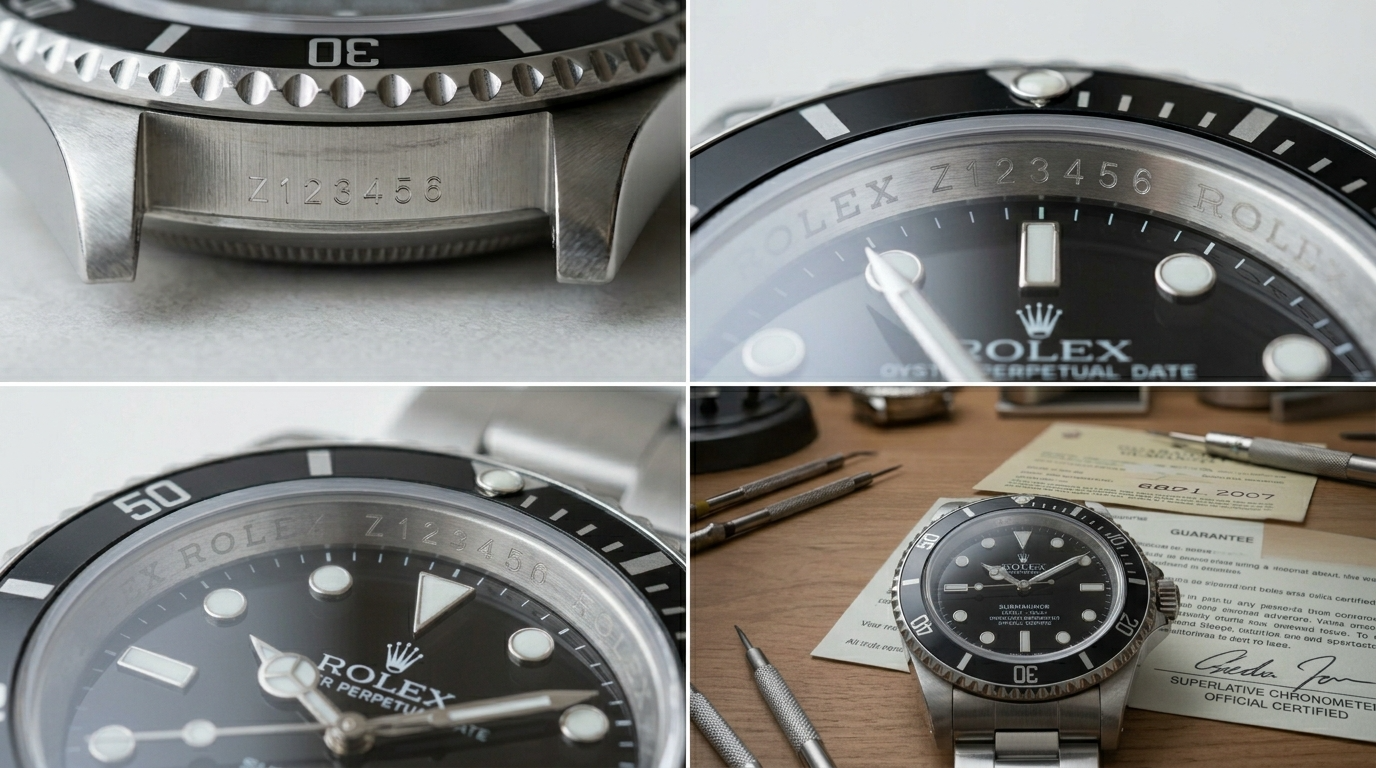
Around this period, Rolex introduced a change that often catches owners off guard. You may find the serial number engraved in two locations on the same watch.
One sits between the lugs at the 6 o’clock position, as seen on earlier models. The other appears on the rehaut, which is the inner bezel just beneath the crystal. This inner engraving usually repeats the word Rolex, with the serial number positioned at the 6 o’clock point.
This overlap phase creates confusion during dating. A watch may carry features from both older and newer production styles, which can lead to incorrect assumptions if you rely on a single detail. Reading both engravings together gives you a more accurate picture of where the watch fits within this transition period.
Post-2008 Models (Rehaut Engraving Only)
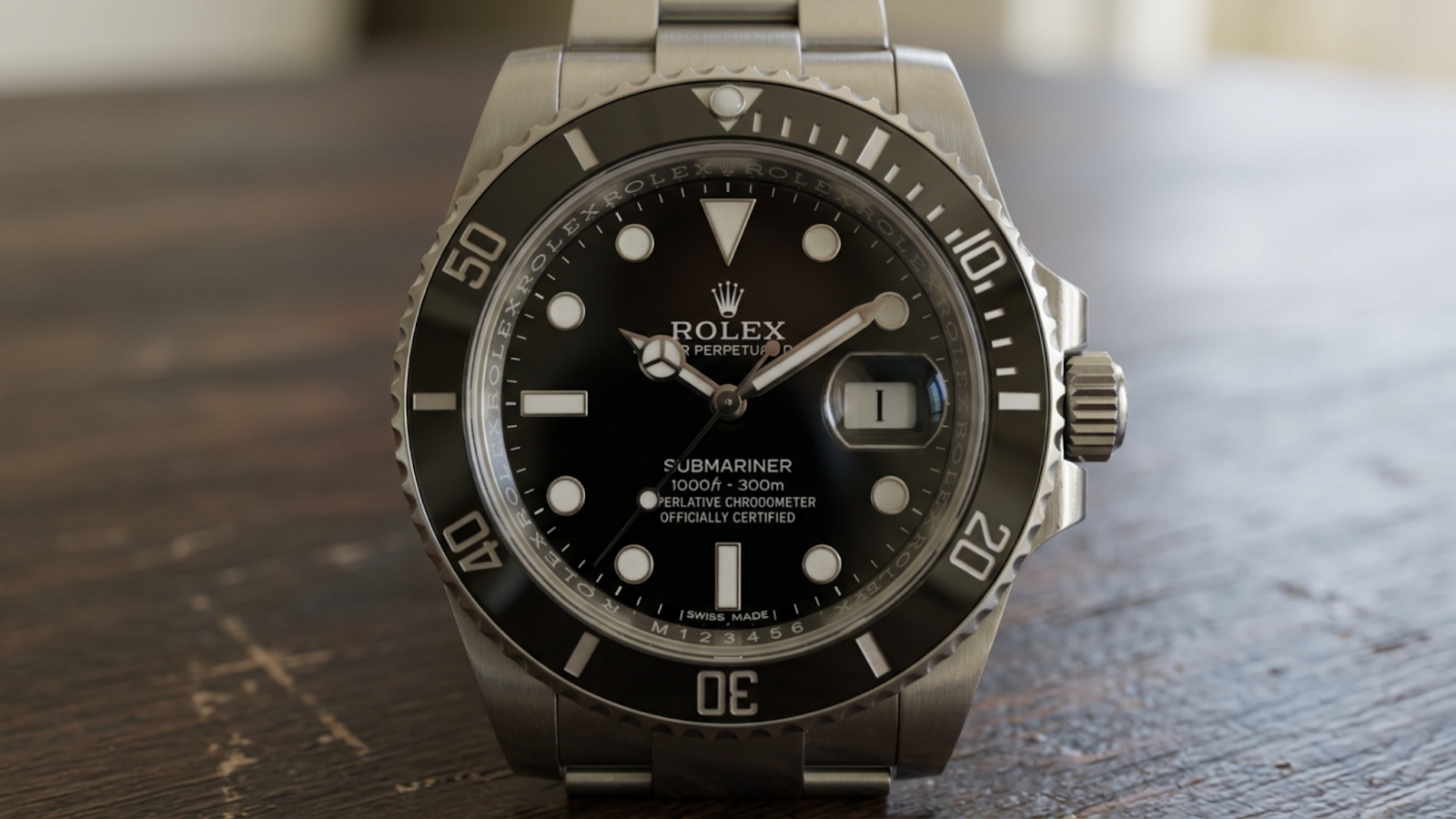
From 2008 onward, Rolex moved the serial number to the rehaut, the inner bezel that frames the dial. You can read it directly from the front of the watch, so there is no need to remove the bracelet.
The engraving is applied with high precision, producing sharp, evenly aligned characters that sit cleanly along the inner ring. Alongside the serial, you will also see repeated Rolex text, with the coronet logo positioned at 12 o’clock and the serial at 6 o’clock.
This shift was not only about convenience. It also added a layer of security, making the serial harder to alter or replicate without detection. For you as a buyer or owner, this placement offers both easier access and a stronger reference point when checking the watch.
How Rolex Serial Numbers Actually Work?
When you look up a Rolex serial number, you expect a clear year. That expectation is what creates confusion.
Rolex does not assign serial numbers when the watch is fully finished. The number is added earlier, when the case is produced. After that, the watch still needs to be assembled, shipped, and eventually sold. This creates a gap between the serial number and the actual sale date.
Because of this, a serial number only gives you an estimated production period. In most cases, the correct range sits within one to two years, not a single fixed date.
To get a more reliable answer, professionals check other details alongside the serial. They look at the reference number, confirm whether the dial matches that time period, and, on older watches, review bracelet codes. For example, if a serial points to 2004 but the model was released in 2005, it usually means the case was produced earlier and used when the watch was assembled later.
Rolex Serial Number Systems
1926–1954: Early Sequential System (5–6 Digits)
If you are trying a Rolex serial number lookup for a very old watch, this is the earliest system you will come across.
Between 1926 and 1954, Rolex used a simple sequential numbering system. Each watch received a number in ascending order, starting from low 5-digit figures and gradually moving into 6-digit figures as production increased.
For context, serial numbers in the 1930s often sit below 100000. By the early 1950s, they had moved into the 500000 to 900000 range. This steady climb reflects growing production, but it was still limited compared to modern standards.
Here is where it gets tricky. These numbers track production flow, not exact release timing. On top of that, surviving records from this period are incomplete, which makes precise dating difficult.
1954 to 1964 Rolex Serial Numbers: Reset and Overlap Explained
By the early 1950s, Rolex had already reached serial number 999999. Instead of moving into 7 digits, the brand restarted the sequence from lower numbers around 1954.
That decision changed how these numbers behave. The same serial ranges began to appear twice, once before the reset and again after it. A number like 100000 or 200000 can belong to watches produced years apart, even though the digits look identical.
This is where surface-level lookup fails. Two watches with matching serial ranges can sit in completely different production windows, and there is nothing in the number itself that tells you which one you are looking at.
To work around this, Rolex added date codes inside the case back during this period, but those are not always accessible and often require opening the watch.
So when you handle a watch from this era, the serial number becomes just one piece. The dial style, movement type, and case details are what anchor the watch to the right timeframe when the number alone points in more than one direction.
1964 to 1987 Rolex Serial Numbers: 7 Digit System Explained
Rolex crossed the 1,000,000 mark in the mid 1960s and expanded serial numbers to 7 digits, marking a clear step up in production scale. From this point, numbers moved upward in a steady sequence, which makes this period far easier to read compared to earlier decades.
You will notice a more predictable flow across years. Watches from the late 1960s sit just above 1,000,000, pieces from the mid 1970s move into the 3,000,000 range, and by the mid 1980s, serials approach 8,000,000. This progression gives you a much tighter estimate when using a Rolex serial number chart.
Even with this improved structure, the system is not exact. The ranges used today are based on collector data rather than official Rolex records.
1987 to 2010 Rolex Serial Numbers: Letter Prefix System Explained
From 1987, Rolex introduced a letter at the start of the serial number, followed by 6 digits. The sequence began with “R” and continued through letters such as L, E, X, N, Y, F, D, and Z as production moved forward.
Each prefix is commonly linked to an approximate production period. For example, R connects to the late 1980s, X appears in the early 1990s, while Y, F, and Z sit in the early to late 2000s.
The system looks clean on paper, but it does not follow strict year boundaries. Rolex assigned new prefixes based on production flow, not calendar changes. As a result, late batches from one letter often overlap with early batches of the next.
2010 to Present Rolex Serial Numbers: Random System Explained
Everything changes once you reach modern Rolex production. From around 2010, serial numbers moved to a fully random alphanumeric format, removing any visible link to production order.
You will see a mix of letters and numbers with no sequence to follow. Unlike earlier systems, no chart can place your watch within a specific year or even a narrow range. For you, this means the serial number no longer helps with dating. It still identifies the watch, but it does not reveal when it was produced.
To understand the timeline, attention shifts to documentation. The warranty card becomes the most useful reference, as it shows when the watch was sold through an authorised dealer. Purchase records and service history can also help build a clearer picture of its age.
Rolex Serial Number Chart with Accuracy Notes
Before using any Rolex serial number chart, one thing matters. Rolex never released official year-based data. Every chart is built from collector records and observed watches, which means all dates are estimates with a possible variation of 1 to 2 years.
What makes this table useful is not just the numbers, but how reliable each range is.
Enhanced Rolex Serial Number Chart
Year
Serial Range or Prefix
Accuracy
What You Should Know
1926
~1 to 20000
Low
Early production, very limited data available
1935
~34000
Low
Sequential system, but poor documentation
1945
~300000
Low
Broad estimates only, heavy reliance on case details
1950
~700000
Low
Pre-reset, but still not tightly mapped
1954
Reset to ~23000
Very Low
Serial restart creates duplicate ranges
1958
~328000
Very Low
Same numbers reused across years
1960
~516000
Medium
Overlap still present but stabilising
1964
~1008889
Medium
Transition into more consistent sequencing
1965
~1100000
High
Start of reliable upward progression
1970
~2240000
High
Strong alignment across collector charts
1975
~3860000
High
Consistent production scaling
1980
~6434000
High
One of the most dependable ranges
1985
~8614000
High
End of full numeric clarity
1987
~9400000 / R
Medium
Shift into the letter prefix system
1990
E prefix
Medium
Prefix linked to period, not exact year
1995
W prefix
High
Stable mapping across multiple sources
2000
K or P prefix
High
One of the most accurate eras
2005
D or F prefix
High
Well-documented production flow
2008
M or V prefix
Medium
Overlap during engraving transition
2010
Random serial
Not usable
No dating is possible via serial
If you want a quick estimate without reading full charts, use this simplified lookup. It works best for watches produced between the 1970s and late 2000s.
Numeric Serial Numbers
- 1,000,000 → around 1964
- 2,000,000 → around 1968
- 3,000,000 → around 1972
- 4,000,000 → around 1975
- 5,000,000 → around 1978
- 6,000,000 → around 1981
- 7,000,000 → around 1983
- 8,000,000 → around 1985
These ranges follow a steady upward pattern, which makes them one of the most reliable periods for serial-based dating.
Letter Prefix Serial Numbers
- R → 1987
- L → 1989
- E → 1990
- X → 1991
- N → 1992
- C → 1993
- S → 1994
- W → 1995
- T → 1996
- U → 1997
- A → 1998
- P → 2000
- K → 2001
- Y → 2002
- F → 2003
- D → 2005
- Z → 2006
- M → 2007
- V → 2008 to 2009
These prefixes give a strong direction, but small overlaps between adjacent letters are normal.
For vintage pieces, always confirm using dial details, case characteristics, and movement type. For modern watches after 2010, this lookup will not apply due to the random serial system.
How to Date Your Rolex? (Quick Method)
If you want a quick estimate without going through full charts, follow this sequence.
- Step 1: Identify the serial number and place it within an estimated range. This gives you a starting point based on known production patterns.
- Step 2: Confirm the reference number to understand when that model was produced. This helps narrow the timeframe significantly.
- Step 3: Cross-check the dial and visible features. Details like lume, font, and layout should match the expected period.
- Step 4: Validate using the bracelet or clasp code on older models, which can indicate production timing down to a specific period.
- Step 5: Adjust for overlap by allowing a 1 to 2 year variation, since serial numbers reflect case production, not the final sale date.
Why Your Rolex Serial Number May Not Match Charts?
You match your Rolex serial number to a chart and expect everything to line up, but the watch in your hand tells a slightly different story. That gap usually comes from how Rolex builds and distributes watches. The serial is assigned when the case is produced, while final assembly and sale can happen later, which shifts the timeline you see on paper.
Other factors add to the mismatch. Reset periods reuse the same number ranges, service replacements can introduce a different case, and widely shared charts are not always perfectly accurate.
A simple example makes this clearer. A serial may point to 1991, while the watch carries features first seen in 1993, which typically means the case was produced earlier and assembled later.
How Professionals Date a Rolex Watch?
A serial number gives you a rough direction, but it is never used in isolation. When a watch is assessed properly, each component is checked against the others to see if the timeline holds up.
Here is how that process works:
- Reference Number: This identifies the exact model and its production span. Once you know the reference, the possible timeframe becomes much narrower.
- Dial Details: Subtle changes in font, lume material, and text layout help place the watch within a specific period. These details are often more telling than the serial itself.
- Movement Type: Each caliber was used during certain years. Matching the movement to the expected production period helps confirm consistency.
- Bracelet and Clasp Codes: On older watches, these codes can point to a specific year or even part of a year, adding another time marker.
- Warranty Card and Papers: For modern pieces, this is the most reliable reference for when the watch was sold and entered circulation.
Can Serial Numbers Prove Authenticity?
No, a Rolex serial number cannot confirm authenticity on its own.
A serial that looks correct can still appear on a watch that is not genuine. Modern replicas are designed to match real serial formats and engraving styles, which means a quick check can be misleading.
This is why professionals do not rely on the number alone. They examine how the watch is built. The quality of the case finishing, the movement inside, and the weight of the materials reveal far more than the engraving.
What matters is whether everything lines up. The serial, reference, and physical details should all match the same model and production period. If only the serial fits, the watch still requires deeper inspection.
What Your Rolex Serial Number Really Tells You?
A Rolex serial number gives context, not certainty. It helps place a watch within a production window, but the level of accuracy changes with each era. Earlier models carry wider ranges due to resets and overlaps, while modern pieces offer no usable dating insight through the serial alone.
A proper assessment looks at the full watch. At Time Is Money Watches, each piece is reviewed by checking the serial, confirming the reference, and examining every component to ensure everything aligns before any valuation is made.
This level of verification leads to pricing that reflects the actual watch and allows precise sourcing when building or upgrading a collection.
If a Rolex is being bought, sold, or traded, relying only on a serial chart leaves too much open. A professional evaluation brings clarity and reduces risk in high-value decisions.